




What does Suu Kyi really stand for?
The release of Aung San Suu Kyi and her public speeches and statements made in freedom have drawn worldwide attention.
The release of Aung San Suu Kyi and her public speeches and statements made in freedom have drawn worldwide attention.
Malaysiakini interviewed Maung Zarni, a Research Fellow with the London School of Economics and Political Science (LSE), again to explore various critical dimensions of the latest political development in Burma.
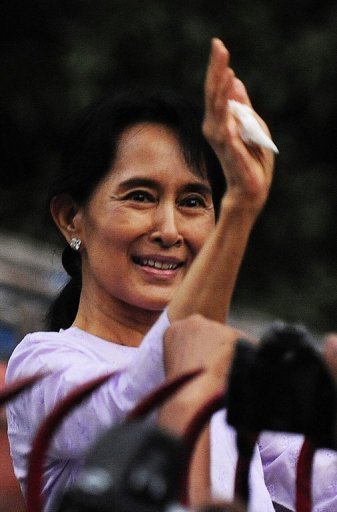 Malaysiakini
:
After being freed from house arrest without condition, Aung San Suu Kyi has reiterated the call for democracy and freedom of speech for the people of Burma. But, she also reportedly said that she would work for national reconciliation.
Malaysiakini
:
After being freed from house arrest without condition, Aung San Suu Kyi has reiterated the call for democracy and freedom of speech for the people of Burma. But, she also reportedly said that she would work for national reconciliation.
There is a 'realist' or 'conservative' observation, however, that these are contradictory messages because the ideal of democracy and freedom of speech would clash with the objective of national reconciliation as Burma still faces ethnic tensions which could lead to the breakup or 'balkanisation' of the multi-ethnic country. What is your opinion?
Maung Zarni: It is not the freedom of speech or push for reconciliation which will trigger the ‘balkanisation', but the militarism of those in power who pursue zero-sum politics with anyone or any organisation or community, which disagrees with the views or visions or interests of the ruling elite, which radicalises and encourages equally zero-sum reaction from the oppressed ethnic and political communities.
When the regime in power allows for no legitimate political space or establishes mechanisms which will help address differences through peaceful means, violence and balkanisation are the inevitable outcomes.
Quite the contrary, these principles - freedom of speech or reconciliation - when appreciated and observed by all stakeholders are the only safeguards against balkanisation. Countries are not vast prison camps or gulags, whose order and stability can be maintained at gunpoint.
For the foreign governments and entities which fear balkanisation in Burma, the best way to prevent or even preempt this eventuality is to start recognising that the generals and their militaristic autocracy is not the panacea for addressing real and felt ethnic grievances and come up with conflict transformation or serious mediation initiatives.
Given the specific history in Burma which is often marked by violent conflicts among armed ethnic groups and between them and the central regime, can the unity of all the people in Burma and territory integrity of the Union of Burma be safeguarded without a strong military and centralised state?
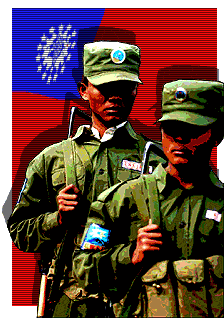 It is not conceivable that the military and its predatory and semi-feudal state will be able to control the multi-ethnic populations of the country at gunpoint for too long, without having to commit a series of genocides or inspire waves of violence across the country. The leaders of Burma's Tatmadaw or "Royal" Armed Forces no longer inspires confidence, love, respect or trust among the overwhelming majority of even the majority Burmese public, let alone ethnic minority communities, and they have become the most reviled men in the country.
The fact that the regime has attempted to control the country, not through genuine political education of communities nor through seeking peaceful resolution of legitimate and real ethnic grievances and injustices, but at gunpoint and through chronic military operations, for half-century, has in fact made the ethnic tensions far worse, and increasingly push the country on the path of ‘balkanisation', providing that geopolitical and geo-economic situations in the immediate neighborhood become favorable to such centrifugal tendencies.
Also the widespread fear of balkanisation one senses, especially from autocratic governments in Asia, such as Singapore, has served the regime in power well.
For it frames the military-state as "too big to fail", so to speak. If you listen carefully to different ethnic resistance groups in Burma, everyone is prepared to live within a single nation-state.
 All that the ethnic communities are asking for is that the state's power structures are transformed into a federal - as opposed to unitary - structure and remove the monopoly grip on the country of a single ethnic group and/or professional class (for instance, the military).
Leaders of ethnic groups are very realistic in that they know no country in Burma's neighborhood will go to war with the Burmese regime in order to support their secession from Burma.
Aung San Suu Kyi also reportedly said that she would ask leaders of Western countries for the easing or lifting of economic sanctions on Burma . Do you think she has mellowed or compromised? What is your own assessment on economic sanctions, whether total or selective?
Economic sanctions is no longer really the problem for the Burmese people as it was back in, say, 2003 when a nascent garment and textile industry was taking roots in the country, which collapsed as a result of the second wave of US sanctions (the first one imposed in 1997 banned only new investment and the second one in 2003 imposed a blanket sanction against all goods sourced in Burma).
If you look at the structure of Burmese economy, agriculture is stuck in 1930s while natural resource extractive sector is the biggest foreign income earner, with an insignificant or non-existent manufacturing sector.
The type of investment that the lifting of sanctions will attract from the West - Asian investors such South Korea, Malaysia, Indonesia, Singapore, Thailand, China and India, are happily and heavily invested in Burma even with sanctions - is for the natural resource and energy sector.
These sectors are capital - and technology-intensive, and do not create jobs or spur a crucial manufacturing sector or transfer skills and technology to local workers and firms. Most importantly, the State and the ruling class in Burma are rent-seeking, kleptocratic, utterly dysfunctional, non-transparent, and not accountable to anyone; nor do they invest in either the people and human resource development or building a sound politico-economic foundation for development.
Anywhere in the world, foreign direct investment and multilateral loans and grants do not necessarily translate into development for the people. Without healthy institutions, capable and enlightened leadership, and the right mix of regulations and economic freedom, lifting sanctions will neither ease the people's hardships nor make Burma a more attractive investment destination, except as a brothel of exploitable above and underground resources.
Like it or not, Aung San Suu Kyi's National League for Democracy (NLD) has been deregistered and she has not been elected in the recent 'elections'. What is her political future? What role can she still plays in politics? Will she return to active politics again? If yes, when and how? if no, what is she going to do next ?
Since when anti-dictatorship politicians, dissidents and icons need to register with dictatorships and seek legalisation of their attempt to change political systems or overthrow tyrants in power?
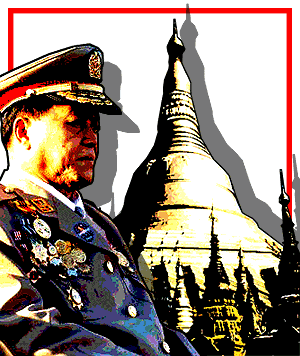 The definition of dissidents in a dictatorship includes the rejection of the legitimacy and legality of the dictatorship. It's the dictatorships that need to legitimise themselves through various farcical processes, such as sham elections. Dissidents are born of oppressed people, and as long as there is popular and active support from the people, dissidents don't need blessings from tyrants!
Even before she was released it became abundantly clear that Aung San Suu Kyi remains extremely popular, both with the domestic public - of all age groups, from youth to elderly and ethnic communities - and the wider international community.
She has already returned to politics, by interacting with her supporters and public at large, inside and, through mass media and electronic communications, outside Burma.
The minute she was released she resumed her political activities - greetings the well-wishers and supporters in front of her house, meeting with her NLD colleagues in the evening, giving interviews to influential international and Burmese media outlets, laying out her platform for reconciliation and interethnic solidarity, repeating her call for dialogue with the ruling generals and offering her former captors an olive branch to start with a clean slate and meeting with different ethnic leaders.
And she has signed the court papers to challenge the regime's ‘judicial' order dissolving her National League for Democracy while organising a second All Ethnic Groups Conference - the first one was held and led by her father in 1947 - to seek peaceful ways for all ethnic groups to address their respective grievances and work out a plan of reconciliation and for re-establishing a Union of Burma where ethnic equality will be as important as economic justice and democratic rights.
There is an observation that while Aung San Suu Kyi's personal charisma and courage to stand firm for her conviction is indeed admirable or praiseworthy, she is also excessively 'idolised' by a segment of the people in Burma and also 'iconised' too much in the international media. Do you share this observation?
What, in your opinion, are the pros and cons of making and preserving her as the only 'idol' and 'icon' of the democratic aspiration and movement in Burma ?
Yes, there has been tendency among a section of Burmese public and internationally to idolise her and put her on a pedestal. There are people who think she can do no wrong.
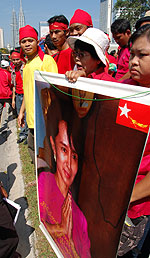 She is acutely aware of this issue and is trying to address it openly. In a BBC interview two days ago, she has emphatically stated that she is "one of the workers for democracy in Burma".
The issue of her charisma and electrifying popularity is a social-psychological dynamic which can be explained this way: the more the public in Burma despises the fat, greedy and nasty generals in power the more the public pour their collective affection and admiration for her.
Among other things, this dynamic between ASSK and the Burmese public and even foreigners who admire her shows an encouraging sign that "the masses" yearn for human leaders who are virtuous, compassionate, honest and people-centered, especially in the ASEAN region where leaders, with few exceptions, are considered corrupt, pathologically paternalistic, autocratic, arrogant, devoid of compassion, humanistic values and egalitarian ethos.
The popular faith in the virtuous power and influence of icons and idols in social world has been as old as ancient civilisations - from virtuous rulers who viewed themselves as Buddhisattavas (or would-be-Buddhas) to Confucian ideals of incorruptible, moral beings playing leadership roles in society.
When institutions are predatory, corrupt and harmful to public welfare, as it has been the case in a place like Burma for the past half century, it is to be expected that the public would bestow trust and confidence in extraordinary individuals who live and die by their belief in politics as public service, not as a venue for self-aggrandisement.


Report this comment
Are you sure you want to delete this comment?
This action cannot be undone.