




Merlimau: Better for Pakatan to field PKR
COMMENT Following the defeat in the Tenang by-election, the time may have come for Pakatan Rakyat to break out of the mould when it comes to the question of which component party should be allocated a seat to contest that has been made vacant by the death of the incumbent legislator. The next by-election in Merlimau provides that opportunity.
COMMENT Following the defeat in the Tenang by-election, the time may have come for Pakatan Rakyat to break out of the mould when it comes to the question of which component party should be allocated a seat to contest that has been made vacant by the death of the incumbent legislator. The next by-election in Merlimau provides that opportunity.
PAS contested there in the 2008 general elections and thus by momentum of the past ought to be conceded the right to stand there in the poll scheduled for March 6.
 All efforts must be made to preserve the coalition's unity and if PAS feels that the seat is theirs by dint of their being the contender in the past, then no quibbles should be raised.
But after defeats in the Galas by-election last November and now in Tenang, is there not cause for a re-think of this reflexive dependence on the right to contest being determined by dint of a party having been a past contender?
Let's face it: the odds are against Pakatan in Merlimau, which is a BN bastion. Therefore thinking out of the box by choosing PKR instead of PAS to contest ought not to be such a stretch.
Of course, the PKR candidate must be reckoned to stand a better chance than the PAS one vis-à-vis BN. Admittedly, this is a dicey question but when the opposition coalition is two-down and its nemesis, BN, appears to be on a roll, such questions beg to be tackled.
Look at the upside to this. Assuming that it is agreed that Pakatan would be better served in the Merlimau poll by fielding a PKR candidate, the public gets to see that the opposition can think afresh, especially when their backs are to the wall.
This would go some distance in dispelling the image BN tries to paint of Pakatan that it's a hodgepodge alliance that will come apart the minute they take federal power.
Of course, PAS could claim that while PKR may come up with a more winning candidate, their party has the better organisation, as was the case in Tenang where PKR's presence were a little short of pathetic.
Granted, pound for pound, PAS can punch higher than their weight all over Peninsula Malaya. But really, in the south of the peninsula, despite the impressive dedication of their cadres, PAS is seen as struggling to make a dent electorally.
There are PAS strategists with the detachment to acknowledge this reality and allow for the need to break out of the mould of thinking that the right to contest a vacant seat should be determined by past practice.
DAP hard at work to get votes for PAS
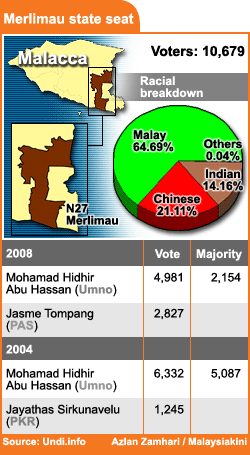
Straightaway, one can say that the 20.8 percent Chinese votes and the 14 percent Indian presence are going to be critical to Pakatan in Merlimau if the latter hopes to reduce BN's majority of 2,154 votes obtained at the 2008 general election.
PKR more than PAS stands the better chance of shaving that majority – and putting skid marks under what would otherwise be a BN roll.
How do we know this?
There is no certain empirical proof of this but the farther one is from the fervent northeast of the Peninsula, the lesser the pull of PAS on the electorate.
By conceding the right to contest in Merlimau to PKR, PAS would open the way to refreshment of the formula for seat allocation within the Pakatan.
As far as is known, there are no hard and fast rules governing this allocation, but with a PAS concession on Merlimau, the party opens the way towards refreshment of a formula that needs more give-and-take among component parties of Pakatan.
PAS has seen how hard the DAP worked in Tenang to get votes for them. The hunch is that the DAP would be hard put to work that way again for them in Merlimau.
Voters in the south of the peninsula are wary of the ideologically rigid as PAS is seen to be with their desire to bar Muslims from working in places serving alcohol.
Down south, voters think that this is a stricture for the more puritanical places in the world; not where people for decades have felt that so long as you don't imbibe, you don't sin.
The bedrock principle underlying the concept of seat sharing among Pakatan should be that all three components get to contest a third of the seats.
So long as that principle is adhered to, what's a little flexibility in respect of particular seat allocations?
Merlimau may be the place where that flexibility could be displayed by Pakatan to demonstrate its ability to think out of the box and show inventiveness under BN pressure.
TERENCE NETTO has been a journalist for close on four decades. He likes the occupation because it puts him in contact with the eminent without being under the necessity to admire them. It is the ideal profession for a temperament that finds power fascinating and its exercise abhorrent.


