




Stop mystifying defence contracts
COMMENT Some defence analysts and a retired admiral have come out in support of the government’s recent purchase of six New Generation Patrol Vessels (NGPVs) costing RM6 billion arguing that these are sophisticated ships and weaponry, thus the price is reasonable.
They have also tried to justify these closed-door negotiations by saying it’s the arms companies that do not want their proposals and offer prices to be available to their competitors.
COMMENT Some defence analysts and a retired admiral have come out in support of the government’s recent purchase of six New Generation Patrol Vessels (NGPVs) costing RM6 billion arguing that these are sophisticated ships and weaponry, thus the price is reasonable.
They have also tried to justify these closed-door negotiations by saying it’s the arms companies that do not want their proposals and offer prices to be available to their competitors.
This is the standard explanation we have been fed all these years to justify the outrageous figures in our military budget compared with the budget for healthcare and other urgent social services.
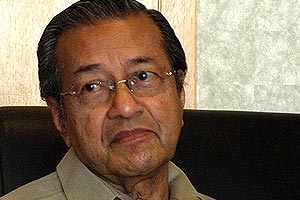 Former premier Dr Mahathir Mohamad in yet another amazing
volte face
has added his voice to the call I made in my latest book ‘Questioning Arms Spending in Malaysia: from Altantuya to Zikorsky’ that our defence budget must be cut drastically in favour of more social services spending. In other words, he is at last ‘asking the right questions’ which our defence analysts seem incapable of doing.
Former premier Dr Mahathir Mohamad in yet another amazing
volte face
has added his voice to the call I made in my latest book ‘Questioning Arms Spending in Malaysia: from Altantuya to Zikorsky’ that our defence budget must be cut drastically in favour of more social services spending. In other words, he is at last ‘asking the right questions’ which our defence analysts seem incapable of doing.
This attempt at mystifying defence contracts has gone on long enough and pretends to be rocket science that taxpayers and members of parliament apparently cannot hope to comprehend. Using the convenient excuse of ‘national security’, the Defence Ministry (Mindef) has shrouded the specs of these sophisticated equipment and weapons systems they are supposed to be fitted with.
The reality and the record of defence procurements by Mindef, including the Royal Malaysian Navy (RMN), read more like a tragedy and comedy of errors. The fiasco of the first six OPVs is not an exception. All this is very costly for taxpayers indeed.
When first announced in 1993, the 27 Offshore Patrol Vessels (OPVs) to be built at the Lumut dockyard were supposed to cost just RM4 billion. Is this new costing at RM1 billion per vessel a fait accompli that taxpayers are now lumbered with? So much for precision planning and KPIs!
The question is not so much whether the cost has been inflated with hidden commissions, but whether can we afford these fabulous warships and if the government has taken steps to ensure the fiasco of the first six OPVs is not repeated.
When the government removes millions of ringgit in subsidies for food items and other necessities, we are told that the country cannot afford these.Nor can the country afford improved healthcare services, housing, school and transport facilities.
But wh
 en it comes to defence procurements, billions of ringgit can be found and the government does not even have to justify such exorbitant purchases.
Israel could afford littoral combat ships because the US had been funding them. Now the US itself is imploding because of its gargantuan military budget and American taxpayers are questioning this funding of the Israeli military. In our case, where will the funding for these six vessels come from?
Record of navy procurements
As we recall the record of Malaysia’s defence spending on the navy, we shall see that this record is not pretty and that Mahathir and then Defence Minister Najib Abdul Razak were responsible for setting off defence spending on an unprecedented upward spiral.
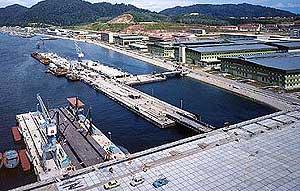
The naval dockyard in Lumut was completed in 1984 at a cost of US$650 million but was not fully used. In 1989, the auditor-general pointed out that the RMN had, because of a staff shortage, sent many ships to private dockyards for servicing.
“…only 21 of the 36 ships scheduled for overhauling in 1986 were serviced in that year and in 1987 only 15 out of 43 ships were overhauled. As a result, the ships were serviced by private dockyards at a cost of $10.28 million in 1985, $7.60 million in 1986 and $10.98 million in 1987.” ( Star , Dec 16, 1989)
Some of the facilities had never been put to use, resulting in deterioration of some equipment. The auditor-general also found that the navy did not comply with regulations when it made bulk purchases of spare parts for its Central Logistics Depot - spare parts and stores valued at $13.4 million for 1986 and $4 million for 1987 had been bought through local orders and quotations when they should have been bought through a contract after a public tender. (ibid)
 In 1991, as a result of the RM5 billion arms deal signed by Mahathir and the Iron Maiden Margaret Thatcher
(right)
, Mindef announced the contract to purchase two corvettes from Yarrow shipbuilders in the UK costing RM2.2 billion. (
NST
, Nov 11, 1991). The cost was $1 billion more than that allocated to the Science, Technology and Environment Ministry for capital expenditure under the Sixth Malaysia Plan.
In 1991, as a result of the RM5 billion arms deal signed by Mahathir and the Iron Maiden Margaret Thatcher
(right)
, Mindef announced the contract to purchase two corvettes from Yarrow shipbuilders in the UK costing RM2.2 billion. (
NST
, Nov 11, 1991). The cost was $1 billion more than that allocated to the Science, Technology and Environment Ministry for capital expenditure under the Sixth Malaysia Plan.
Two weeks later, Najib was quoted as saying the RMN required 16 OPVs. But due to financial constraints, the RMN could only afford four or five of these locally-built OPVs. Mindef budgeted RM85 million per OPV excluding guns. ( NST , Nov 25,1991)
Mahathir and Najib might have done well to ask themselves the wisdom of buying two corvettes for RM2.2 billion or using that budget to buy more than 20 OPVs at RM85 million apiece.
I have delved into the politics and shady deals behind the ‘Arms for Aid Scandal’ in my recent book in which I have pointed out that even other British shipbuilders were unhappy with this exclusive contract given to Yarrow to build the corvettes.
In 1993, Najib announced that the cabinet had given the go-ahead to the RMN to acquire 27 OPVs costing RM4 billion over a 20-year period.
He said that Naval Dockyard Sdn Bhd, the company which took over the naval dockyard at Lumut, had been appointed the main contractor. The construction of the vessels would be spread out from then up to 10th Malaysia Plan; each warship would be 80m long and weigh 1,000-1,300 tonnes, and be fitted with basic armaments including naval guns.
Najib said
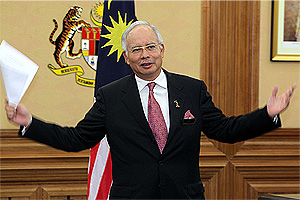 the project represented “the single largest financial forward commitment by the Government in the history of defence equipment procurements”. (
NST
, Sept 24, 1993)
the project represented “the single largest financial forward commitment by the Government in the history of defence equipment procurements”. (
NST
, Sept 24, 1993)
Still, note that the cost quoted for 27 OPVs in 1993 was RM4 billion. By 1997, the project cost had climbed to more than RM5 billion. ( NST , 17.10.97) In recent years, the price quoted for these 27 OPVs became RM24 billion. And now we know that the new cost for just six of these OPVs is at least RM6 billion and no doubt there will be the usual cost overruns!
In my book I have discussed the emergence and growth of the domestic Military Industrial Complex and how this has led to the continuance of non-transparency in the way contracts are given out and how Malaysian taxpayers are subsidising these rather privileged ‘appointed’ local contractors.
When this project was announced, Najib said although the decision was to equip these ships with basic weapons, the missiles and other sophisticated weaponry could be installed later when the funds were available.
He added that several pieces of equipment including the engine, armaments and the command and control systems would be supplied by the government. And as a national project, the government might provide funds in the form of loans or additional equity to enlarge Naval Dockyard’s capacity to undertake the project. (ibid)
How much subsidy has gone into these privileged companies in the Military Industrial Complex all these years? Have our economists counted the cost?
The first vessel was expected to be ready within 48 months after the signing of the agreement between Naval Dockyard and the chosen foreign firm (i.e. by 1997). The dockyard would then produce two ships a year.
The German consortium, German Naval Group was the selected partner to the Malaysian consortium, Penang Shipping Corporation-Naval Dockyard Sdn Bhd (PSC-NDSB), led by Amin Shah Omar Shah.
Let's debate defence policy
PSC-NDSB was privatised in December 1995 for RM300 million and the agreement included the rights to provide maintenance work and services to all RMN vessels for 15 years, besides construction of the 27 NGPVs.
By the mid-
 2006, only two barely operational patrol boats had been delivered. In 2007, the auditor-general tabled a report in Parliament alleging that the contract given to PSC-NDSB was in serious trouble. There were 298 recorded complaints on the two boats, which were also found to have 100 uncompleted items in one boat and 383 in the other.
According to the auditor-general, 14 progressive payments amounting to RM943 million had been paid out despite the fact that he could find no payment vouchers or relevant documents dealing with the payments. He attributed the failure to serious financial mismanagement and technical incompetence stemming from the fact that PSC had never built anything but trawlers or police boats before being given the contract by Mindef. (Auditor-General’s Report 2006, Sept 7, 2007)
The Auditor-General’s Report estimated that the government could claim at least RM214 million in penalties for the late delivery of the two OPVs and non-delivery of the remaining four. However, the cabinet decided to waive the claim of penalties and even awarded the contractor an increase in the contract price of RM1.4 billion in January 2007. Mindef paid in advance RM4.26 billion to the contractor in December 2006 when the progress of the work done only amounted to RM2.87 billion. (ibid)
Despite the fiasco and the great financial loss to taxpayers, the mammoth contract was awarded to yet another local company - Boustead Holdings which effectively took control from Amin Shah.
Amin Shah suffered no greater punishment than being reduced to the status of ‘non-executive chairperson’ in the company. Now, which Malaysian would not want to be a favoured bumiputera entrepreneur like Amin Shah who could get away so lightly after such a fiasco?
It is time to o
 pen our defence policy for public debate. The people need to be told who our perceived enemies are so that we can discuss the best means to combat these threats. The government should be made to produce annual defence White Papers and be open about all these defence procurements. Our defence analysts know that the specs for these vessels will ultimately be known anyway and the justification for secrecy in contract negotiations is so much
taurus turdo
.
pen our defence policy for public debate. The people need to be told who our perceived enemies are so that we can discuss the best means to combat these threats. The government should be made to produce annual defence White Papers and be open about all these defence procurements. Our defence analysts know that the specs for these vessels will ultimately be known anyway and the justification for secrecy in contract negotiations is so much
taurus turdo
.
Finally, it is unclear whether these fabulous defence equipment are in the national interest or merely to fill the construction orders of another vested interest, namely our local Military Industrial Complex.
Read what was reported last year to justify this second batch of NGPVs: “(The prime minister) was keen for the commitment to a second batch of NGPVs as its naval shipbuilding facilities currently has no further naval construction orders…Prime Minister Najib Abdul Razak added that the fact that Boustead had over 2,000 subcontractors dependent on it was further reason for the government to continue the NGPV programme with a Batch II order.” ( Defence Review Asia , Mar/Apr 2010, Vol 4, No 2)
Notice that in 2010, Boustead was supposed to have over 2,000 subcontractors dependent on it. In the latest announcement of the purchase of the six NGPVs, Mindef said there were precisely 632 vendors in the shadow of Boustead. It seems that in the defence industry, not only is the equipment mind-boggling, even simple arithmetics can be mystifying.
By the way, do Malaysians know we lost an entire warship, the KD Sri Inderapura in 2009 not through heroic combat with an imaginary enemy boat but through sheer negligence when a fire on board was not properly doused?
No doubt Mindef will announce the purchase of a replacement Multi-Purpose Support Ship. There will be a fabulous price tag attached to it and the defence analysts and retired admirals will be wheeled out to justify the procurement with just the appropriate dash of armaments mumbo-jumbo…
KUA KIA SOONG, a former MP, was principal of the New Era College, Kajang. He is also a director of human rights group Suaram.


Are you sure you want to delete this comment?
This action cannot be undone.