




'Expand Klang Valley bus service now'
There is an immediate need to increase the number of buses serving the Klang Valley, for short-term relief of traffic congestion as well as to complement the MRT system when implemented.
There is an immediate need to increase the number of buses serving the Klang Valley, for short-term relief of traffic congestion as well as to complement the MRT system when implemented.
Making the call in a statement today, DAP publicity secretary Tony Pua said the Land Public Transport Commission (or Spad by its Malay acronym) appears to have written off buses as an effective means of public transportation.
He quoted
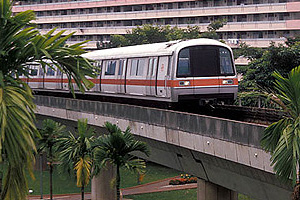 a statement by NGO Transit yesterday that the average daily ridership of MRT in Singapore is 1.95 million, which is only about 63.2 percent that of buses at 3.09 million.
This is despite the fact that Singapore has an extensive MRT network of 130km with 79 stations, said Pua, the Petaling Jaya Utara MP.
"It also leads to the conclusion that Singapore has a world-class public transport system precisely because of the prominence and role which buses play, as both an alternative and a complement to the MRT system in the city state.”
 Pua also cited the example of Hong Kong, with 212km of Mass Transit Railway and rail services with 150 stations ferrying an average of 3.76 million passengers a day. Its extensive bus service network ferries an equal number of passengers or more daily.
This proves that, in any successful public transport model, bus services form one of two critical pillars and its contribution cannot be under-estimated.
Pua then contrasted the situation in the Klang Valley where RapidKL, the main bus service operator, has only about 800 buses to service a population of 6 million spread over an area of 2,800 sq km.
"This is a far cry from Singapore which has more than 3,300 buses servicing 5 million people (over) 482 sq km or Hong Kong which has more than 5,500 buses servicing 7 million people within an area of 1,095 sq km."
‘Draw up bus service blueprint’
Pua suggested that a plan to increase bus services should precede the implementation of the MRT mega-project for two reasons.
First, it would immediately provide relief in terms of traffic congestion and reducing the cost of living for people. Second, it would be a much cheaper option compared to the MRT project.
"Assuming each bus costs RM600,000, 'flooding' the Klang Valley with an additional 3,000 buses will only cost RM1.8 billion, a tiny fraction of the RM46 billion bill for the MRT," he explained.
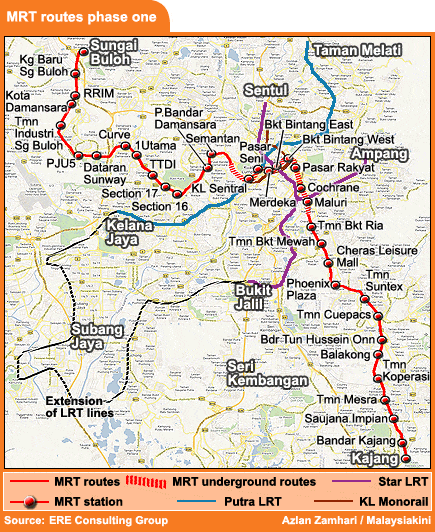
Therefore, Spad should come up with a bus service blueprint as an adjunct to the MRT blueprint to 'complete' the public transport equation for feedback and evaluation by the Klang Valley community, said Pua.
"Otherwise the risk is (that) Malaysians are being presented with a massive RM46 billion proposal which may fail to achieve its lofty goals of transforming our public transport landscape."


Are you sure you want to delete this comment?
This action cannot be undone.