




MTUC: Less workers joining unions not shameful
There is a worrying trend that less workers are joining unions in the country but this is nothing to be ashamed about.
There is a worrying trend that less workers are joining unions in the country but this is nothing to be ashamed about.
Malaysian Trade Union Council (MTUC) Penang branch chief S Ravindran said that less than 10 percent of workers in the country are members of unions but this was a global phenomenon.
What was more important, he added, was the composition of the members, as the union needed all kinds of people for strength.
"We need those who can negotiate with employers, those who can organise pickets, even those who can bang the table during negotiations to get the best deals for their members," he said, during a dinner event to commemorate a belated Workers' Day.
"Join us, do not be scared of anyone and let the union help you as we even help those who are not represented in our unions," he urged the 300 strong crowd who attended the event in Butterworth last night.
Minimum wage
On why the Workers Day celebration was held in June, Ravindran explained that it was shelved due to various programmes in April and May.
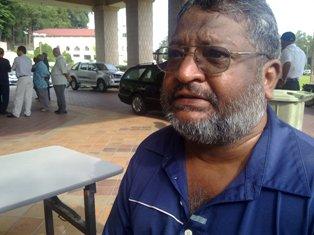 Penang MTUC branch secretary K Veeriah (
right
) urged the government to stop dilly-dallying in implementing the much talked about minimum wage for workers.
Penang MTUC branch secretary K Veeriah (
right
) urged the government to stop dilly-dallying in implementing the much talked about minimum wage for workers.
Prime Minister Najib Razak had said recently that the minimum wage policy for low-income workers would be implemented at the year-end, after the establishment of the National Wage Consultative Council.
"We have waited too long...promise after promise was made...but we remain disappointed," he said.
Veeriah also expressed hope that the government would not amend the Employment Act as it had attempted to do last year. The move was halted by opposition from unionists.
There had also been plans to amend two other laws - The Industrial Relation Act 1967 and the Trade Union Act 1959.
Each of these amendments , claimed its opponents, was designed to benefit foreign direct investment and would further erode workers rights.
"If it did go through (the amendments), the life of workers would have been worse off. In fact, the government should make the laws for workers more flexible, so that they can live and work more comfortably," he said.
"The situation, however, remains complicated while bosses continue to oppress workers who are involved in unions," he added.
He gave the example of a company who made life difficult for its workers when an in-house union was established.
"We had to lodge a report with the Human Resouces Ministry...this kind of thing should not happen anymore but it will continue as long as employers have a mindset that is still in the dark ages," he lamented.
Fighting spirit missing
Meanwhile, Industrial Relations officer N Balakrishnan lamented about the dire state of affairs regarding unions in the country.
He said the fighting spirit he witnessed in the 70s was no longer as obvious these days.
In the 70's, especially in Penang and Prai, he added, many who were not highly educated nor knowledgeable or experienced in labour laws, joined the unions and were very active.
What they had was the courage and the spirit to fight for the rights of workers and bring about better working conditions despite their lack in education or experience in issues concerning workers.
"At that time, the struggle was "cermelang" and union leaders were held in high esteem," he said.
"But strangely, those who were involved in the struggle then, had left us last year. They left within a few months of each other," he added, sadly.
He spoke fondly of three most active but now deceased unionists - Francis Xavier, R Sivalingam and KR Raja Gopal - good friends who died within a few months of each other.
Their next of kin were later given plagues of appreciation to honour their lifelong struggle and commitment to workers rights.
"They fought for workers' rights regardless of race and religion. We had already put the ‘1Malaysia' concept into practice a long time ago. What we have now is merely propaganda," he said.


