




A house split from within must fall
COMMENT A house divided against itself must fall.
Or rather, a hitherto dominant political party which has lost the allegiance of two of its once favourite sons must be headed for oblivion.
That at least were the visions conjured by two of Umno’s detractors over the weekend.
The two Umno dissidents, Tengku Razaleigh Hamzah and Anwar Ibrahim, the latter not so much a dissident as an intended reformer-turned-oppositionist, within hours of each other, provided the intellectual and moral bases for the downfall of Umno-BN in the looming 13th general election...
COMMENT A house divided against itself must fall.
Or rather, a hitherto dominant political party which has lost the allegiance of two of its once favourite sons must be headed for oblivion.
That at least were the visions conjured by two of Umno’s detractors over the weekend.
The two Umno dissidents, Tengku Razaleigh Hamzah and Anwar Ibrahim, the latter not so much a dissident as an intended reformer-turned-oppositionist, within hours of each other, provided the intellectual and moral bases for the downfall of Umno-BN in the looming 13th general election.
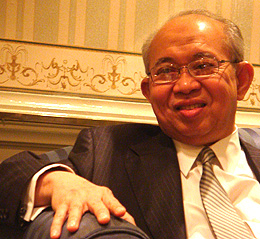 Razaleigh, in yet another of his discourses in Taiping on Saturday night on the state of the nation,
outlined
the imperative reasons for that fall; Anwar, parliamentary opposition leader, rallied at Shah Alam yesterday the PKR component of the tripartite Pakatan coalition he leads, for
the final push
of Umno-BN over the electoral precipice.
Razaleigh, in yet another of his discourses in Taiping on Saturday night on the state of the nation,
outlined
the imperative reasons for that fall; Anwar, parliamentary opposition leader, rallied at Shah Alam yesterday the PKR component of the tripartite Pakatan coalition he leads, for
the final push
of Umno-BN over the electoral precipice.
One leader spoke of the politics of cant, of “double think” and “double talk” as having put the skids under Umno-BN over a 30-year period and brought economic and institutional malaise to the country.
The other leader, a perennial target of that malaise, conjured visions of his party’s “finest hour” to rally the troops for a “five percent swing” in the vote which he said would bring Umno-BN’s downfall at the fast approaching general election.
An inventory of BN failures
One need not have been a listener or observer at the two leaders’ orations to conclude that the Umno-BN government was ripe for the picking; merely listening to both politicians’ coherent and compelling narrative of the cumulative ideological and moral failings of the ruling coalition was enough to convince that the malaise had reached a critical stage.
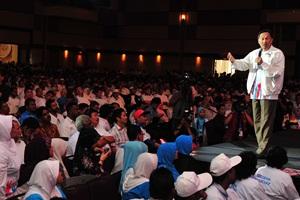 “Never underestimate the wisdom of the masses,” emphasised Anwar to the 2,000-odd party faithful that had gathered at the Shah Alam Convention Centre yesterday for an intensive briefing on PKR’s preparations for the polls which the party expects by end July.
In tones resonant of his readings in the psychology of the masses by the Spanish philosopher Ortega y Gasset, Anwar urged party’s election cadres to persist with the familiar themes of Umno-BN failure: inflation, subsidies to independent power producers, Port Klang Free Zone fiasco, the unexplained deaths of Teoh Beng Hock and Ahmad Sarbini Mohamed.
In other words, Anwar was saying that the inventory of BN failures, with which the people were familiar, had gone beyond the limits of plausible explanation and failure.
Hence the “five percent swing” in the vote tally of the last general election - away from the BN - at the coming polls, a swing that is possible by faith in the “wisdom of the masses” to think and decide who should lead them, would see Pakatan enthroned in Putrajaya.
Not always on same wavelength
On his side of the rhetorical equation, Razaleigh had outlined what had happened to Umno-BN in the last 30 years of its now 54-year incumbency as the ruling coalition.
He said Umno-BN had allowed wanton centralisation of power in the Office of the Prime Minister and the attorney-general, spawning in the process a system of interlocking interests between political elites and their business cronies.
Razaleigh said this system had led to glaring disparities in income distribution not only between racial groups but also within each race.
He said that leaders bereft of what he called “generational responsibility”, which he defined as a solemn duty of care for future generations, stoked racial and religious obscurantism to ensure that Malaysia’s multi-racial and multi-religious people remained immured in cultural ghettoes and hostage to the manipulation of powerful elites.
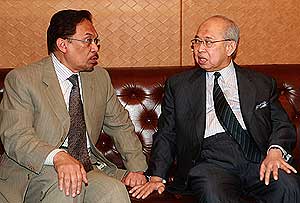 Razaleigh and Anwar have not always been on the same wavelength on what ails Malaysia and how to go about remedying the ills.
On the one side, there is a lack of trust about the other’s motives and on the other, there is distaste for the hesitation that makes for captivity to indecision.
But sometimes, deep and momentous change in politics is brought to fruition only because of improbable alliances and unlikely partnerships.
Razaleigh has outlined the causes of the economic and institutional malaise in Malaysia while Anwar has transmuted travails endured as a consequence of that decay into popular support for a compelling coalition for the restoration of “generational responsibility” in national leaders.
The time is nigh for that duty of care to move leaders, coloured in different hues and alloyed in varied moulds, to rise to the challenge of national restoration.
TERENCE NETTO has been a journalist for close on four decades. He likes the occupation because it puts him in contact with the eminent without being under the necessity to admire them. It is the ideal occupation for a temperament that finds power fascinating and its exercise abhorrent.


