




Gov't will decide on wage floor
Human Resource Minister S Subramaniam admitted that ultimately it is the government that calls the shots in setting the benchmark on the minimum wage.
Human Resource Minister S Subramaniam admitted that ultimately it is the government that calls the shots in setting the benchmark on the minimum wage.
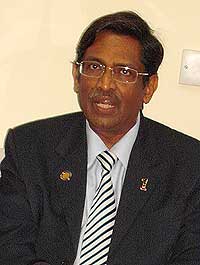 In commenting on the National Wages Consultative Council Bill, which was tabled for first reading on Monday, Subramaniam guaranteed "fair consideration" would be given to the council's recommendations to the government.
Asked on criticisms that the bill was not up to mark and was vague on specifics, Subramaniam said, "We will take the views of the council, give it great importance. That is why we (will) appoint the council and that is why we want them to deliberate."
The final decision on setting the rate of the minimum wage, he conceded, would still lie with the government.
"The government makes the decision. This is practised in most parts of the world... when there is a tripartite consultation, based on this consultation, the government decides," he said.
Bill a 'waste of time'
Opposition MP Charles Santiago (DAP-Klang) said the bill was "a waste of time" as the minister has the power to decide on decent wages.
"The minister can implement minimum wages already. All he has to have is a technical committee that can advise him on the wages and he can sign on the minimum wages and it can be implemented," said Charles in another press conference in Parliament today.
"Thus the setting-up of a National Wages Consultative Council is redundant, a waste of public funds and it introduces another bureaucratic layer in wage determination," he said.
The council will be responsible for carrying out studies on all matters concerning minimum wages and to make recommendations to the government on minimum wage levels according to sector, types of employment and geographical region.
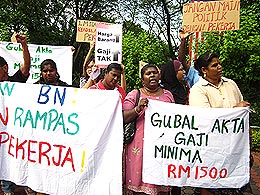 Charles also chided the ministry for not defining a minimum wage framework to guide the council in its deliberations.
When pressed on the matter, Subramaniam agreed that the bill does not have a definition of the wage floor, but added, "no act would state the amount anywhere in the world."
"But we (the ministry) do not decide (on the rate). They (the council) make the decision and it goes to cabinet. If cabinet does not agree, it refers it back to the council.
"There are some countries where the government decides on its own. In our case, there is a tripartite consultation and then the government decides and we will definitely give value to the tripartite consultation," he assured.


