




PM fudges on repeal of UUCA
Prime Minister Najib Razak was non-committal last night when asked if he would amend or repeal the Universities and University Colleges Act 1971 (UUCA), which has been highly criticised for curtailing the political freedom of students.
Prime Minister Najib Razak was non-committal last night when asked if he would amend or repeal the Universities and University Colleges Act 1971 (UUCA), which has been highly criticised for curtailing the political freedom of students.
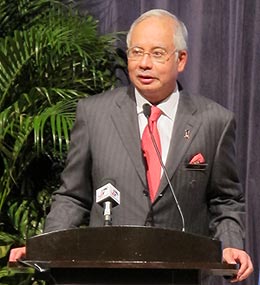 To a question at a dialogue last night with young professionals in Kuala Lumpur, Najib said he is "open about it" but stayed ambivalent on his administration's commitment to granting students political freedom.
"I'm still open about it. But I would like to ensure there is stability in the campuses. If it is too open, then students will be involved in intra-party politics. But I do want to encourage students to decide for themselves.
"And we can encourage more activities in the campuses so that students will have an open mind on what is happening in the country," said Najib in a curt reply.
He was speaking to several hundred participants at ‘An Evening with the Prime Minister’, organised by the Young Corporate Malaysians (YCM).
The individual who posed the question was Universiti Kebangsaan Malaysia (UKM) student Woon King Chai, who has been charged with violating provisions of the UUCA.
Woon was among four political science students who had been nabbed by the police for allegedly campaigning for the opposition during the 2009 Hulu Selangor by-election.
Although they were later freed, the quartet was then hauled up by UKM's disciplinary committee and asked to show cause. They filed a court injunction against the disciplinary proceedings, but this was rejected and the matter is now pending appeal.
The four have completed their final semester of studies but their graduation date is uncertain because the disciplinary proceedings are scheduled for July 4.
Their predicament earned them much media attention, even in the New York Times which published a report on the issue last December.
Woon had asked the premier about his thoughts on amending the UUCA and went on to remind Najib that he had said in April 2009, shortly after taking office, that the era of "government knows best" was over.
"What are your views on allowing students to have the responsibility to choose and decide for themselves?" asked Woon, triggering hoots of approval and applause from the floor.
YCM was established in January 2008 by a group of young professionals with the objective of building a network of young professionals through various informative and social events.
High car taxes a form of ‘sacrifice’
Another question which was well received from the floor was about the lowering of excise duties on imported cars.
To this, Najib candidly said he could only do so if his government is able to find additional revenue elsewhere.
 “I’m speaking as the minister of finance. If you can tell me where to find additional revenue, I will reduce the price of imported cars. I cannot raise income tax or the price of RON95 (grade petrol). My options are limited.
“I believe one day (such as when we) introduce GST, which is a consumption based tax, I can look at ways to reduce tax on imported cars. It is a zero-sum game. Something has to give,” he said, laughingly.
Najib warned the budget needs to be balanced, citing how developed economies in Europe have suffered financial problems in recent times due to imprudent financial management.
He said he considers hefty imported car taxes as a form of “sacrifice” needed for long-term gain.
However, this earned him a follow-up question from another member of the audience who asked why the government did not tighten its belt, such as in the case of power purchase agreements (PPAs) between independent power producers (IPPs) and Tenaga Nasional Bhd.
To this, Najib attributed the first generation of PPA contracts, which have been heavily criticised for being lopsided in favour of the IPPs, to government inexperience in negotiations during the early 1990s.
He said these contracts are currently being reviewed and would be subject to renegotiation.
'Malaysians are underpaid'
On the possible detrimental effects of a minimum-wage policy, Najib said young professionals should aim to arm themselves with innovation and creative ways to increase their wages.
“I think that Malaysians are underpaid,” said Najib to applause from the floor.
 “If you look at Malaysia, professional services, doctors, engineers... they are not getting the salaries commensurate with the skills that they have.”
He said that keeping costs low in order to be competitive is a thing of the past and new technology, higher productivity, innovation and other new others are needed for workers to have an competitive edge.
A recurring question during the session was on inflation, to which the premier said one must value the fact that many staple goods in Malaysia are still cheap.
“I think we are still pretty competitive. You can live quite comfortably in Malaysia. Sugar, fuel, rice, flour are still the cheapest in the region,” he said.
He said that at three percent, inflation is still manageable and stressed that the situation should be viewed as a global phenomena.


Are you sure you want to delete this comment?
This action cannot be undone.