




Kids of mixed parentage in S'wak can be 'natives'
There is an opening for children of Chinese fathers and native mothers to declare themselves as natives of Sarawak, according to state Minister with Special Functions Adenan Satem.
There is an opening for children of Chinese fathers and native mothers to declare themselves as natives of Sarawak, according to state Minister with Special Functions Adenan Satem.
"These children should go to the Native Court and let the court declare them as natives, provided that they meet certain requirements," he said yesterday.
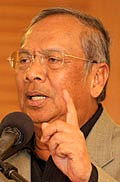 Adenan (
right
) was replying to points raised during the debate on the address by the Yang di-Pertua Negeri in the state legislative assembly.
Adenan (
right
) was replying to points raised during the debate on the address by the Yang di-Pertua Negeri in the state legislative assembly.
"The effective word is ‘identify' with a native community," he said, meaning that those concerned should speak the native language and practise their culture and traditions.
"They must convince the Native Court that they have indeed identified themselves with the community."
Adenan said the state government is aware of some problems faced by children of mixed parentage.
"In respect of children of native and non-native parents, the federal government had with effect from November 2009, administratively agreed to recognise such children in Sabah and Sarawak as bumiputeras.
"All federal agencies have been instructed to abide and implement this decision. The Sarawak government agrees with this stand (of) the federal government."
However, Adenan clarified that the administrative decision is for the purpose of education and scholarship only.
"The offspring of Chinese fathers and native mothers are not automatically natives in Sarawak," he said.
He said Sarawak would not follow Sabah to automatically declare these children as natives.
"In Sabah, the offspring of mixed parentage are deemed to be natives, as long as one of the parents is native.
"But we are not going to follow them because their circumstances are different. As far as Sarawak is concerned, we do not want to see a dilution of this status because we know the natives of Sarawak attach great value to their status, and that they are very jealous and they don't want their position to be easily diluted."
Native identity
When negotiations on the formation of Malaysia were in progress, Adenan said, the native leaders of Sarawak had submitted a memorandum to the Cobbold Commission on the issue of native status.
"The memorandum showed that they were very jealous of this position as they wanted both parents to be natives for their children to be natives. But if one of the parents are not, then we can take some administrative measures."
The natives of Sarawak are the communities listed in the state's Interpretation Ordinance. The term is defined by Article 44 of the state constitution and Article 161A of the federal constitution.
"The general practice, not of law, is that if the father is a native and a mother is not, the children are deemed to be natives. This is because we take a paternalistic approach, administratively, that their offspring are accepted as natives," he said.
On the issue of the Berawan and Saban tribes not being listed as natives of Sarawak, he said they come under the generic term of ‘Orang Ulu' which covers the Kelabit, Kenyah, Kayan, Lun Bawang and Penan, among others.
"Therefore, although the Berawan and Saban are not included in the Interpretation Ordinance as natives, they are in fact natives of Sarawak," he said.
"But if they want the state and federal constitutions to be amended to include them as natives, then they must prove that they are distinct communities. We are not averse to amending the constitutions."
 Adenan said the
Adat Istiadat
of Sarawak and
Adat Kelabit
are also applicable to the Saban as their culture and traditions are closely associated with those of the Kelabit.
Adenan said the
Adat Istiadat
of Sarawak and
Adat Kelabit
are also applicable to the Saban as their culture and traditions are closely associated with those of the Kelabit.
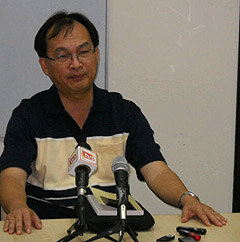
Ba'Kelalan assemblyperson Baru Bian ( left ), who is a Lun Bawang, said there are "a few thousand" Berawans and Sabans in northern Sarawak.
"In the case of Saban, you cannot find them anywhere else in Borneo," he told reporters at the state legislative assembly media centre.
He said anthropological evidence shows that the Berawan were the first tribe to have set foot in northern Sarawak.


Are you sure you want to delete this comment?
This action cannot be undone.