




A politician both made and marred by business
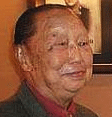
COMMENT Just three months after the party whose ideal of multi-racialism he strove to uphold was blanked out in the Sarawak polls, James Wong Kim Meng, one-time parliamentary opposition leader, died in Kuching at the age of 89.
His epitaph would be obvious: He resisted ethnic captivity in politics.
Wong's half century straddled the time of Sarawak's merger with the Federation in 1963 and ended almost 50 years later when his party, Sarawak National Party (Snap), was de-registered in 2002.
Along the way, he gained such estimable offices as Sarawak deputy chief minister and parliamentary opposition leader...
COMMENT Just three months after the party whose ideal of multi-racialism he strove to uphold was blanked out in the Sarawak polls, James Wong Kim Meng, one-time parliamentary opposition leader, died in Kuching at the age of 89.
 His epitaph would be obvious: He resisted ethnic captivity in politics.
Wong's half century straddled the time of Sarawak's merger with the Federation in 1963 and ended almost 50 years later when his party, Sarawak National Party (Snap), was de-registered in 2002.
Along the way, he gained such estimable offices as Sarawak deputy chief minister and parliamentary opposition leader.
An 18-month detention in Kamunting under the notorious ISA, endured when he was parliamentary opposition leader, served only to confirm that a life in Malaysian politics, especially on the opposition benches, cannot be exempt from privations of the inflicted kind.
But self-imposed travails are another matter, with Wong having unwisely inflicted it on his party through sackings in the early 1980s, among the expelled being Daniel Tajem and Edmund Langgu.
The latter were for the assertion of Dayak aspirations in politics and economics, while Wong tried to hold steady the banner of multi-racialism.
Wong, who had been a financier (from timber logging) of Snap after he joined the party in 1963, won the internecine argument.
The upshot: the losers, led by Leo Moggie and Tajem left to form Parti Bansa Dayak Sarawak, touching off the splintering of the Dayak vote, a perennial sideshow to Sarawak's ongoing main drama of Melanau dynastic domination scripted by uncle Rahman Yakub and nephew Abdul Taib Mahmud.
Challenger and collaborator
Throughout this four decade-old saga, James Wong had roles that alternated between being a challenger of the ruling orthodoxy and a collaborator in the schemes of the powerfully-placed.
The fixed point in the variables was what was good for Limbang Trading, his commercial flagship.
Wong, knowing well the logistical costs of campaigning in a sprawling state, proved a shrewd judge of how to blend politics with business. The one without the other is soon submerged in the infested waters of Sarawak politics.
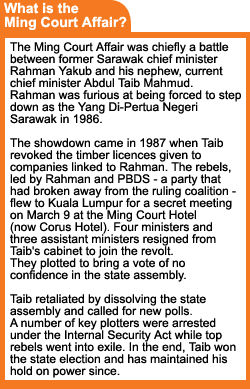 In the Sarawak's critical battle for power in 1987, latter dubbed the ‘Ming Court Affair', Wong feinted in the direction of support for the rebels against Taib Mahmud before opting for the role of tribune to the triumphant.
Limbang Trading turned out to flourish further but Snap fell to the machinations of ruling coalition overlords who fortify their writ by encouraging proxies to do their divisive bidding.
When one factional battle resulted in Snap's de-registration in 2002, Wong resorted to legal remedy. Vindication came eight years later when Snap was given a new lease on life, but Wong was by then in advanced dotage.
When he died yesterday, his revived party was in the throes of trying to recover its allure of yesteryear, when it was the focal point of Dayak support.
James Wong's political career was both made and marred by business. The subtext of his career is the impossibility of the politics-business mixture in a democracy.
TERENCE NETTO has been a journalist for close on four decades. He likes the occupation because it puts him in contact with the eminent without being under the necessity to admire them. It is the ideal occupation for a temperament that finds power fascinating and its exercise abhorrent.


Are you sure you want to delete this comment?
This action cannot be undone.