




Ku Li's Amanah: Nostalgia or a stalking horse?
COMMENT Is Amanah, the NGO that Tengku Razaleigh Hamzah launched today, a stalking horse for a slate of candidates the Umno dissident is maneuvring to field at the 13th general election?
 This speculation inevitably arose as news broke earlier this week that Angkatan Amanah Merdeka (Amanah), already dubbed the ‘NGO of nostalgia' for its aim in recapturing the country's lost age of innocence, was to be formed.
But sources close to Razaleigh say this is not the case. They claim that Ku Li, as he is popularly known, in agreeing to launch and head Amanah, is only responding to a groundswell of nostalgia for the values that Malaysia's founding prime minister Tunku Abdul Rahman sought to inculcate...
COMMENT Is Amanah, the NGO that Tengku Razaleigh Hamzah launched today, a stalking horse for a slate of candidates the Umno dissident is maneuvring to field at the 13th general election?
This speculation inevitably arose as news broke earlier this week that Angkatan Amanah Merdeka (Amanah), already dubbed the ‘NGO of nostalgia' for its aim in recapturing the country's lost age of innocence, was to be formed.
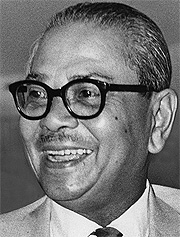 But sources close to Razaleigh say this is not the case. They claim that Ku Li, as he is popularly known, in agreeing to launch and head Amanah, is only responding to a groundswell of nostalgia for the values that Malaysia's founding prime minister Tunku Abdul Rahman sought to inculcate.
Certainly, the choice of venue for the launch - the Tunku Abdul Rahman Memorial Hall - bolsters the theory that Amanah intends to re-forge the Tunku's now-forgotten agenda.
This, throughout his political career, was the cultivation of a harmonious multi-racial, multi-religious country in which citizens respected their different beliefs and helped each other to get ahead in life.
In other words, a country that mirrored the values that the Tunku believed and practiced in his own life, values that Razaleigh outlined in prepared remarks he made at Amanah's launch this morning.
The Tunku's values, as described by Razaleigh, were the values of responsible work and concern for the welfare of the less fortunate, a love of sport and the teamwork and good cheer it encourages, and a delight in family life and the simple pleasures of life.
Razaleigh said the values cherished by the Tunku made for a happy family and, by extension, a happy nation which he said was what Malaysia was when the Tunku was in charge.
Prolonged amnesia
The Gua Musang MP aired his theory of how Malaysia has deviated from the happy trajectory that the Tunku had set for it during his 13-year premiership (1957-70).
According to Razaleigh, Malaysia's present unhappiness is the compounded result of prolonged amnesia about values that the Tunku upheld.
Where the Tunku had been personally free of corrupt practices, now we have rampant corruption permeating all levels of society and government; where the Tunku had rich friends with whom he enjoyed a game of cards and horses races but there the links stopped, we now have cronyism and sweetheart business deals from the politician-business tycoon nexus; where the Tunku fostered inter-race harmony, we now have communalism fanned by entrenched interests; where the Tunku counseled moderation through respect for different beliefs, we have extremism and ethnocentrism; and where the Tunku was a man of simple tastes and pleasures, we have now ostentatious opulence and extravagance in high places.
In sum, according to Ku Li, there's nothing unusual in the way the family spirit that the Tunku exuded and sought to diffuse in the nation has come to grief.
The country, or rather leaders who came to lead the country, had not just ignored the Tunku's values, they sought to have them permanently interred.
Aside from a sniggering suspicion that this is an overly romantic view of Malaysia's beginnings as an independent nation, there is also the school of thought that the Tunku, a royal with the common touch, misjudged the great sleeper issue of the 1950s and 1960s - how and at what pace to lift the Malays out of their poverty in the kampongs of rural Malaysia.
Ideas on how to do that were more to be found among the left-wing intellectuals of Malayan and (then) Malaysian society, a social layer the Tunku, by reason of his aristocratic birth and light-feathered temperament, was not comfortable with.
He was a man of generous instincts but had little or no intellectual curiosity.
By the time the great sleeper issue detonated in May 1969, with menacing effects on his stature as a Malay leader for a multi-racial and multi-religious nation, it was too late to do anything but to "yield with a grace to reason/and bow and accept the end of a season" (as the poet Robert Frost put it) - the season of his preeminence as Malaysia's political No 1.
An unending quest
Nothing so became the man as his departure from power, by no means an easy thing to do, judging from similar episodes in last half century of post-colonial history in Asia and Africa.
During the year and a half between the first alarums that the Tunku must go (May 1969) and his actual departure from prime ministerial office (September 1970), there was a period of roiling contemplation, of whether to stay and fight those in Umno who wanted him out or to leave gracefully, with the party safe from divisive conflict.
In this period, at one of those socials that were common in that era, the Tunku spotted Razaleigh, and as one royal to another raised a quizzical look, "Oh, you're here?"
The Tunku had heard that Razaleigh was more with those who wanted him removed than with his elder fellow aristocrat; hence the query.
The incident is described in the author Ranjit Gill's book, ‘Razaleigh: An Unending Quest'. The book reports that Razaleigh then held the view that "Doc was entitled to his views."
It's blasé to speculate who that "Doc" referred to and what those views were.
All that was to come in terms of amnesia that Razaleigh now says has led to the evisceration of the Tunku's values occurred on the watch of that "Doc".
As to the chances of restoration of those values happening on Razaleigh's watch as premier, that calculation is what makes Malaysian politics much like the interesting times a Chinese sage once pronounced as a wish on others.
TERENCE NETTO has been a journalist for close on four decades. He likes the occupation because it puts him in contact with the eminent without being under the necessity to admire them. It is the ideal occupation for a temperament that finds power fascinating and its exercise abhorrent.


Are you sure you want to delete this comment?
This action cannot be undone.