




PAS Youth: EC finally admits existence of phantom voters
PAS Youth today said that the Election Commission (EC) has finally admitted to the existence of phantom voters on the country’s electoral rolls, confirming fears that the entire process will be compromised by duplication and non-existent voters.
PAS Youth today said that the Election Commission (EC) has finally admitted to the existence of phantom voters on the country’s electoral rolls, confirming fears that the entire process will be compromised by duplication and non-existent voters.
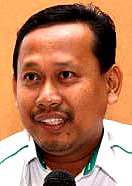 PAS Youth’s democratic rehabilitation and mobilisation committee chairperson Suhaizan Kaiat (
right
) said EC deputy chair Wan Ahmad Wan Omar had “indirectly admitted” to the existence of phantom voters on the electoral rolls, when the latter made a statement to
The Star
last weekend.
PAS Youth’s democratic rehabilitation and mobilisation committee chairperson Suhaizan Kaiat (
right
) said EC deputy chair Wan Ahmad Wan Omar had “indirectly admitted” to the existence of phantom voters on the electoral rolls, when the latter made a statement to
The Star
last weekend.
On Sunday, The Star quoted Wan Ahmad as saying that the EC needs the help of political parties and individuals to purge “clones” from the electoral rolls.
He said the EC had “never denied the existence of clones”, stressing that it requires teamwork between the EC, political parties and all registered voters to clean up the rolls.
Suhaizan, who is also Johor PAS Youth chief, said the EC’s latest statement was based on data that he made public last week, claiming that there were multiple entries for voters who have both new and old registered identity cards.
“This statement is a u-turn by the EC, which in the past denied the existence of phantom voters and even accused Pakatan Rakyat of making up stories to dent confidence in it (EC),” he said in a statement.
 Suhaizan has so far revealed two cases of double registration of voters on the electoral rolls, which he said can be checked by anyone on the EC’s
website
.
Suhaizan has so far revealed two cases of double registration of voters on the electoral rolls, which he said can be checked by anyone on the EC’s
website
.
The first case involved one Mariam Binti Su, who was registered with two new registered identity cards (NRIC) - 720616025472 and 720610025738 – despite only having one old IC, A2278510.
A second case involved one Murugan a/l Subramaniam, who was registered with the same birth date, gender, voting locality and state and parliamentary constituencies, but with two NRICs that are nearly identical save for the last four digits.
Murugan, whose old IC number was A2909056, is currently registered under two NRICs, 731002025877 and 731002025201.
Major flaws in system
Suhaizan stressed that the two examples highlight two major mistakes made by the EC and the National Registration Department (NRD), in that the NRD had issued one old IC to two individuals while the EC has allowed individual voters multiple voting rights.
He said the EC and NRD have applied the wrong standard operating procedures for their computer database system, which was set up to weed out overlapping identifiers between new and old ICs.
“But the NRD has allowed overlapping old ICs and the EC has accepted wrong data in registering legal voters. This is proof of the EC’s and NRD’s mistakes. Any party has the right to lodge a police report on the negligence of the NRD and EC,” he said.
Suhaizan noted however that despite the proof of overlapping data in the electoral rolls, the EC has no right to strike out the compromised list, as it must go through a lengthy court process to prove there is a prima facie case to prove the legality of a voter’s status as required by Section 14 of the Election Regulations (Process of Elections) 1981.
“If elections are held in the near future, then the 13th general election will be using questionable electoral rolls. With the data on questionable voters, any party that wins in the 13th general election could have their victory nullified.
“This is a serious issue that is bound to happen. PAS Youth urges for a royal commission to be formed to study the country’s problematic electoral system,” he said.


