




Special privileges for asylum seekers sent from Australia
Eight hundred displaced persons seeking asylum in Australia, to be housed in Malaysia as part of a bilateral refugee swap deal, will receive special treatment, above and beyond what is afforded 90,000 refugees already in-country.
Eight hundred displaced persons seeking asylum in Australia, to be housed in Malaysia as part of a bilateral refugee swap deal, will receive special treatment, above and beyond what is afforded 90,000 refugees already in-country.
One such consideration is they be allowed to work while being quartered in Malaysia, which is currently denied to other refugees and asylum seekers.
 "Yes, definitely," said Home Minister Hishammuddin Hussein when pressed by reporters on whether the 800 will be allowed to work.
Asked if the same rights will be accorded to other refugees and asylum seekers in Malaysia, Hishammuddin said that it is something for the long term.
"We will have to do it in the time frame that is available. But we have to look at the peculiar circumstances of each case," said the minister in a verbal sidestep.
Hishammuddin then said that the arrangement with refugees and asylum seekers in Malaysia, is that they are to await resettlement in third countries.
"They may not even want to work here," he said, non-committally.
‘Peculiar circumstances'
The "peculiar circumstances" in this case is that the Australian government will be paying for some of the ‘special treatment' to be given to the 800 asylum seekers.
As the Australian Minister for Immigration and Citizenship Chris Bowens told reporters, his government will fork out 296 million Australian Dollars to finance the refugee swap.
The funding, according to the text of the agreement signed, is for health, welfare, education, transportation, and "additional ‘safety net' costs".
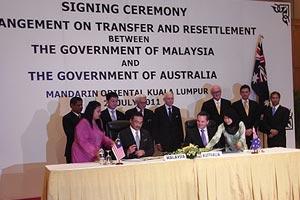
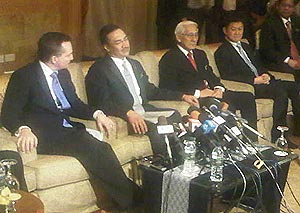 Bowens and Hishammuddin were speaking to reporters at a press conference after signing the bilateral refugee for asylum seeker swap agreement between the governments of both countries in Kuala Lumpur today.
The deal will see 800 asylum seekers who land in Australian shores be housed in Malaysian facilities while Australia will take 4,000 displaced persons recognised by the United Nations High Commissioner for Refugees (UNHCR), off Malaysia's hands.
This arrangement will be in force for a period of four years, after which it may be renewed.
The arrangement also stipulates that the government of Malaysia must extend to the 800, not only the same support it accords to other displaced persons, plus certain ‘safety net' provisions.
Another clause of particular import is that the government of Malaysia is to undertake, is to ensure that the 800 to be given special identification, jointly issued by both countries and treated as legal refugees.
A particular problem facing UNHCR recognised refugees in Malaysia is persecution by law enforcement and the paramilitary Volunteer Corps (Rela).
Numerous cases of genuine refugees being detained by authorities even with their UNHCR identification, are on record.
‘UNHCR to monitor'
Contacted by Malaysiakini , the UNHCR affirmed that it had noted the bilateral arrangement signed today between the two nations.
The world body pointed out that it is not a signatory to the arrangement, however it appreciates
that both governments have consulted with its office.
While not professing any objections to the refugee swap deal, UNHCR made clear its preference that all asylum-seekers arriving by boat into Australian territory to be processed in Australia, consistent with global practices, something which the refugee swap deal elegantly circumvents.
However the UN agency recognises that the deal has "important protection safeguards...including protection against arbitrary detention; lawful status to remain in Malaysia until a durable solution is found; and the ability to receive education, access to health care, and a right to employment".
The world body believes that the acid test for the deal will be in its implementation both in Australia and Malaysia.
UNHCR states that it will continue to monitor and review progress of the agreements as it is implemented.


Are you sure you want to delete this comment?
This action cannot be undone.