




'Gov't crackdown on PSM to defend crony capitalism'
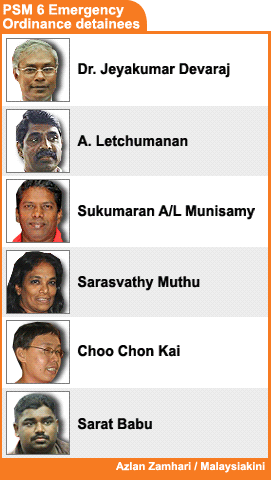
It is still a mystery to many why the six Parti Sosialis Malaysia (PSM) activists currently detained under the Emergency Ordinance (EO), but one activist has said it is because of the party's relentless struggle against the government’s capitalist policies and its cronies.
It is still a mystery to many why the six Parti Sosialis Malaysia (PSM) activists are currently detained under the Emergency Ordinance (EO), but one activist has said it is because of the party's relentless struggle against the government’s capitalist policies and its cronies.
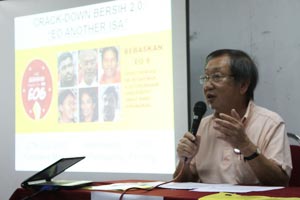 Bersih 2.0 coordinator Toh Kin Woon
(right)
said PSM has persevered in its struggle against a host of other issues affecting the livelihood of citizens, and this has irked the government into its ridiculous action against the six.
Bersih 2.0 coordinator Toh Kin Woon
(right)
said PSM has persevered in its struggle against a host of other issues affecting the livelihood of citizens, and this has irked the government into its ridiculous action against the six.
These include fighting for the halt of the government’s privatisation drive, against poverty, GST and a host of other issues, said Toh, who was a former Penang exco member under the Gerakan-led administration prior to 2008.
Compared to other political parties, Toh asserted further, PSM has also been the most consistent in terms of its struggle.
Toh, who is Lim Lian Geok (LLG) cultural and development centre chief, said he believes the government feel that “unless PSM's struggles are nipped in the bud from the very beginning, the interests of their cronies would be challenged," he told a 200-strong forum on the EO in Penang last night which was moderated by Amnesty Malaysia executive director Nora Murat.
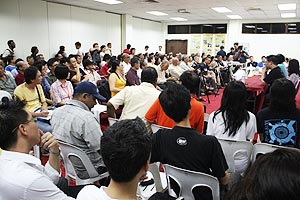 "PSM's struggle may be slow but they are consistent, so the authorities feel it is better to halt the movement now," he told the the forum last night organised by several civil society organisations including Sembang-sembang, Concerned Group of Citizens and Aliran.
Last night's event also saw the participants holding a candlelight vigil by the roadside outside the compound of the Caring Society, which is situated next to the Penang Governor's residence.
The peaceful gathering saw banners being held up, chanting against the EO and demands for the release of the six PSM activists currently in detention under the law, while a few vehicles tooted their horns in support of the participants.
The six, including Sungai Siput MP Dr D Jeyakumar, have been detained since July 2 for their alleged involvement as the key planners of the Bersih 2.0 rally on July 9 in Kuala Lumpur.
Still under emergency rule
Meanwhile, lawyer Clement Ong reminded the participants that since the late 1940s, five states of emergency have been imposed on the country for a variety of reasons by the nation’s top leadership.
 Ong (
left
) listed all five periods as having occurred during the
Ong (
left
) listed all five periods as having occurred during the
- communist insurgency (1948-1960)
- Indonesian-Malaysian Kronfrontasi (Sept 3, 1964)
- Sarawak constitutional crisis (June 14, 1966);
- May 13 racial riots (May 15, 1969); and
- Kelantan constitutional crisis (Dec 8, 1977).
"The only time in Malaysia's 53 years of independence the country was not under the state of emergency was for three years between 1960 to 1964," he told the audience.
"The other states of emergencies are yet to be abolished or lifted," he added, in the two-hour event.
Ong, (left) who lectures at various institutions, also explained the main differences between the Internal Security Act (ISA) and the EO, both of which allow for indefinite detention without trial.
‘All-powerful laws must go’
 "The only difference between the two laws is that for the ISA, the Home Minister has to sign the charge sheet, while for the EO, the IGP's signature is enough," he said.
An EO prison term could go to two years, then subsequently extended if directed by the police chief.
The EO acts as a convenient means by which the police puts suspected criminals behind bars as well as to evict urban settlers from ‘squatter’ areas, as often happens in Selangor,
Ong urged the government to end the current state of emergency the country was still in, and highlighted the fact that up to June 13, 2009, there had been 971 arrests under the EO.
At the same forum, the younger sister of Jeyakumar', Dr Prema Devaraj, spoke on the background of the ‘PSM 6', all of whom she had come to be acquainted with over the years.
She also spoke about the conditions of her brother's imprisonment and the possibility of harsh treatment the detainees may be subject to since their arrests in late June.
 Prema (
right
), who is also programme director at the Women's Centre for Change, questioned the six’s incarceration, pointing out that it was not a crime to be a socialist.
Prema (
right
), who is also programme director at the Women's Centre for Change, questioned the six’s incarceration, pointing out that it was not a crime to be a socialist.
She appealed for continued support for the activists, pointing out that the detention has not been easy for anyone, whether "inside or outside" the prison.
"When a government is afraid of free and fair elections, when they shudder at a yellow t-shirt, when they use the tools of the state to lock-up decent people, it becomes exceedingly clear, at the next general election that this government must be voted out," she asserted.


Are you sure you want to delete this comment?
This action cannot be undone.