




Hudud and our shared political future
The debate over whether to implement hudud law in Malaysia resurfaced again recently, with controversial remarks made by the leading lights of the DAP and PAS.
This is a longstanding topic of great importance among Muslims and non-Muslims alike.
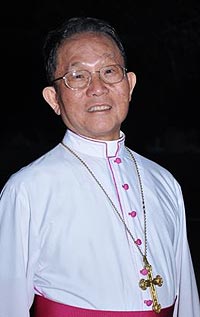 The Catholic Bishop Dr Paul Tan Chee Ing has made a subtly nuanced statement that he has no objection to Muslims in Kelantan to propose the Hudud law, if the people insist on it, and if that is also the expressed wish of the non-Muslims in Kelantan.
This is an epoch-making statement that reflects a much more open stand than before, on the thorny issue of the Islamic state.
For the first time, the Catholic Church has come out openly to state that they have no opposition to the proposal for Islamic law in Kelantan, if there are iron clad guarantees that the fundamental rights of non-Muslims will be protected.
I am glad this new development has taken place.
Like the rest of us, the Catholic Church has probably been infected by the air of religious and political optimism created by the events of the Arab Spring.
The Arab Spring has opened the eyes of the world to the long-suppressed, dormant complexity of the Muslim perspective.
In recent times, no thanks to the 911 attacks on American targets, Islam has suffered from a jaundiced portrayal of Muslims as a bunch of narrow-minded sectarians.
The Arab Spring has revealed how diverse the Islamic worldview truly is, in the actual creation of history.
This kind of inter-civilisational dialogue, between the Muslim world and the rest of this large universe is sorely needed.
Such a dialogue has often been hijacked by political slogans in the past, instead of featuring enlightened debate.
The crux of the question remains that the decision to implement Hudud law, or not, is a matter for Muslims to decide among themselves, in accordance with the dictum of self-determination by the people belonging to that religious community.
Listening with the heart
There is no reason for non-Muslims to jump up in horror, and condemn PAS and their followers as religious extremists.
Non-Muslims have to cultivate the virtue of listening with their hearts open, expressing their sincere views on the subject, while also keeping their eyes wide open. There is no need to start a hate campaign against PAS out of blind reaction.
We must not forget that PAS is a legitimate political movement, which can be a force for good in Malaysian society.
 The consistent stand of PAS against corruption, abuse of power, and for clean politics, is a position which non-Muslims can support without any difficulty.
While I disagree with turning Malaysia into an Islamic state, I think Kelantan may warrant exception, and I do respect and admire the crucial role of many of the political positions of PAS, in furthering the cause of democracy in Malaysia.
I know many leading PAS personalities myself, and I have no lack of regard for their show of political integrity. PAS is a political force that can provide great benefit to Malaysian democracy.
Abstract possibility
Any ambivalence in my support for PAS is made easier by the fact that the Islamic state in Malaysia will probably remain in the realms of abstract possibility forever, rather than a concrete historical reality.
The Islamic agenda of PAS is filled with seemingly insurmountable obstacles, and is nearly certain to remain unattainable, except in Kelantan.
After all, Malaysia is an undeniably multi-racial society where non-Muslims make up nearly half the population.
Even among the Muslims in our country, not all support the idea of an Islamic state, and Malaysia has the necessary constitutional guarantees to ensure that our nation will remain as a secular state.
The salvation of Malaysia's multi-racial future may lie in the hands of the eastern states of Sabah and Sarawak. In those two states, Muslims form a minority, with Christians making up the majority.
Despite the popularity of PAS in peninsular Malaysia, the party's idea of theocracy has never been popular in Sarawak and Sabah, even among the Muslims there.
 It is therefore unlikely that the Islamic state will be accepted by all Malaysians, of all races and faiths.
We are poised at a critical stage of our national development. The most crucial transformation required is for our politics to evolve into a competitive two-party system, so that an alternative government can be formed in the federation.
That is the most urgent turn of events we must see, in order for Malaysia to become a real democracy.
Whether Kelantan will become an Islamic state or not is of course an important issue, but not as important as the opening up of our entire Malaysian society, in political terms.
What we need now is for a change of government at federal level, to cement our political practice of having real choice, and checks and balances.
This will determine the democratic future of Malaysia for many generations to come - but only if we embrace that desperately needed transition.
SIM KWANG YANG was member of Parliament for Bandar Kuching, Sarawak from 1982 to 1995. He can be reached at sky8hornbill@gmail.com. All comments are welcomed.


Are you sure you want to delete this comment?
This action cannot be undone.