




Penang Hospital earns 'fish market' tag
There is a running joke among patients that the orthopaedic clinic at the Penang General Hospital (GH) is akin to a fish market.
The crack, however, applies to other clinics in the government hospital as well, including its pharmacies.
There is a running joke among patients that the orthopaedic clinic at the Penang General Hospital (GH) is akin to a fish market.
The crack, however, applies to other clinics in the government hospital as well, including its pharmacies.
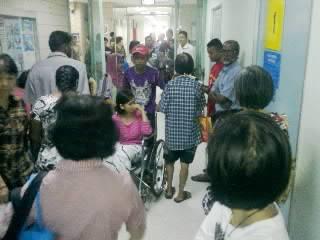 Patients arrive as early as 6am to place their cards at the counter and to book seats, which are insufficient, as they are usually accompanied by relatives or helpers.
Even by 9am, most of the patients have yet to be issued with a number to see their doctors.
The waiting and hunger (shops within the GH open only at 8am) make the patients, especially senior citizens, restless, anxious and frustrated.
A patient, with an arm in plaster cast, said his only son sent him to the hospital at 6.30am, before breakfast, and left him there to go to work.
"He could not stay as he had to rush to work. Work is hard to come by these days. One can't be absent unnecessarily.
"Besides, he is the only breadwinner in the family," said the forlorn pensioner, who wanted to be known only as 'Uncle Lee'.
War zone-like counter
The counter behind a glass window, where the patient numbers are given out, is like a war zone.
There are only two clerks manning the counter and they appeared to be overwhelmed with the workload, even though it was still early in the day.
Their tolerance was further tested by patients or their relatives and helpers crowding in front of the counter, waiting for their names to be called.
Despite being in crutches or plaster casts, many tried to shove RM5 at the clerks to get priority for their numbers.
RM5 is the amount paid for the hospital services by patients who are not civil servants, while pensioners are exempted, and only need to show their pension cards.
The jostling led to a minor shouting match between patients at one point, with one patient saying, "Get away from the counter. Don't crowd the place... my name is being called but I can't even get to the counter!"
Other patients, especially the wheelchair bound, appeared frustrated because their journey into the clinic is a nightmare in itself.
Nightmarish journey for handicapped
Their pathways are literally blocked by the crowd, in no mood to queue up, shoving and pushing to get their numbers.
The patients expressed fear, and some have experienced passers-by crashing into their plastered feet or legs, compounding their problems.
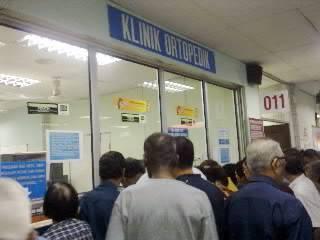 After struggling through the hurdle of getting the number and card, a patient is huddled into the doctor's area.
The narrow room is another marketplace, albeit a tiny one, where patients, doctors and nurses are sardine-packed into a 10 by 10 feet space.
This is impractical for an orthopaedic ward, especially for those in crutches and wheelchairs, who need a wider space to move around.
A doctor admitted that "the place is a mess. People have to complain or else things will not improve".
The doctors are young and appear very kind when tending to their patients, irrespective of ethnicity or age.
Former Aliran president P Ramakrishnan, who was at the ward for a shoulder problem, pointed out that there was no one to guide the patients, resulting in the jam along the entrance.
Lack of guidance is a problem that another orthopaedic patient, a retired nurse, soon found out.
After obediently queuing up for a number to collect her medication, she was told to go to another counter several rooms away.
Being wheelchair-bound and with pain in her right leg, this was an annoying task, as she had already been at the hospital for three hours, moving from one section to another.
"Go to room 014A," the retired nurse said the pharmacist told her. "They (the orthopaedic clinic) have their own medicines there. How the hell am I supposed to know that?" she asked, exasperated.
"They should have told us this at the clinic itself. I am wheelchair-bound and yet I have to move to three to four places before I can complete my visit," Madam SS Chong exclaimed, flabbergasted.
Five-fold rise in patients
When contacted, the Penang GH Board of Visitors representative Tan Khai Beng said this was a familiar scene, not only in the government but at private hospitals as well.
Tan said the early birds wanted to be the earliest to see the consultants for fear of being scheduled later in the afternoon, usually after lunch.
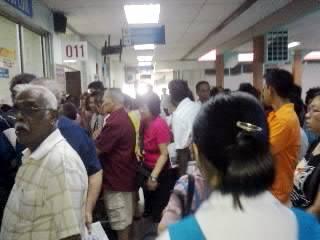 The consultants, he said, would normally see their first patients at around 10.30am, after their ward rounds, a normal practice at all hospitals.
"We have discussed this issue with the GH as we are aware of this problem and the hospital is looking into this, with the view of having at least a specialist around for consultation," he told Malaysiakini .
Tan said of late there had been an overwhelming number of patients, with the numbers having jumped significantly from around 2,000 in 2008 to about 10,000 patients a day now.
The hospital is finding it difficult to cope with this influx and parking remains a great problem, despite a new multi-storey car park having been built, he said.
"All the clinics have been expanded drastically to cope with the influx and during Chinese New Year, it was worse as many were on leave, leaving only a few nurses to cope," he said.
Priority for wheelchair-bound patients
As for the tiny consultation rooms, Tan said the hospital was short of space and the Health Ministry was considering a proposal to put up a new 11-storey block.
"For now, everyone has to live with it," said Tan, who is the Bukit Bendera MCA division deputy chief.
On a related matter, he said wheelchair-bound patients were given priority, and "they need only ask".
Patients also needed to ask their doctors for information, or else they would be presumed to be aware of the situation.
Tan was referring specifically to the retired nurse's complaint that she did not know where to collect her medication as the pharmacy gave her the run-around, despite she being wheelchair-bound.
"If she doesn't know too bad... she needs to ask around or, if it is her first time, ask the doctor where to get the medicines," he explained.
"If you don't ask the doctors, they will presume you know, because there are simply too many patients waiting to see them."


Are you sure you want to delete this comment?
This action cannot be undone.