




On the hustings, Najib assumes presidential style
COMMENT 'Don't use your mind too hard/But trust my instinct, I'm in charge.'
With a little tinkering, these lines from the poet Robert Frost could usefully reflect the essence of Prime Minister Najib Razak's campaign theme in what pundits say is the final prelude to the 13th general election.
The PM is campaigning throughout the country, leveraging on all the cultural and religious festivities he encounters on the hustings, to tell voters to relax and trust his instinct for the concerns they have are best left to his trusty care...
COMMENT 'Don't use your mind too hard/But trust my instinct, I'm in charge.'
With a little tinkering, these lines from the poet Robert Frost could usefully reflect the essence of Prime Minister Najib Razak's campaign theme in what pundits say is the final prelude to the 13th general election.
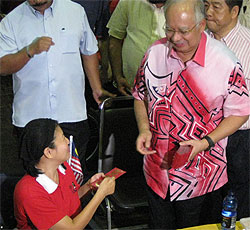 The PM is campaigning throughout the country, leveraging on all the cultural and religious festivities he encounters on the hustings, to tell voters to relax and trust his instinct for the concerns they have are best left to his trusty care.
One is hard put to find parallels from the past for perspective on what has become the essential feature of the PM's style on the campaign trail which can be summarised as ‘Trust my instinct, I'm in charge.'
When before has the magnetism of a leader's personal popularity been sufficient to obviate the defects of his administration and the tawdry legacy it inherited?
This question arises because it is quite obvious now that Malaysia's sixth prime minister's essential sell is that the country needs change and it is he who will usher it in because it is him who is saying so.
He knows what he has got to do but...
Consider the way the international news magazine The Economist puts it in its latest edition: "Over the past two years this English-educated son of an earlier prime minister has positioned himself as a bold moderniser.'
The operative words here are ‘this English-educated son of an earlier prime minister.'
One may well be accused of being Anglo-centric, but the phrase could only mean someone who has the education and pedigree to avoid being the local version of Bashar Assad, a ruler who if he has heard of the Arab Spring must think it a version of the ‘bird flu' that threatened to become a pandemic some years back.
The news magazine was saying that, assuredly, Najib knows what he has got to do; only, it qualified, he has not dispelled doubts as to whether he is able to do what he has to.
Unfazed by the cavils of others, the PM on the campaign trail is essentially saying to voters, ‘Douse your doubts, trust my instinct, I'm in charge.'
He told Malaysian Hindus who are celebrating the festival of Thaipusam today to place "their nambikei (trust) in the government."
Perhaps, decorous self-effacement restrained him from personalising ‘government' in that sentence, but that is what his theme is: ‘The government has not been very good, I know, but trust me for I'll change things.'
The phonetics in ‘nambikei' has got more lilt than ‘makkal shakti' (people's power) had in 2008 when the opposition used the slogan to rally voters, particularly Indian Malaysian voters, to their best performance in a general election since 1969.
The 1969 polls are instructive here: that was the last time a sitting prime minister banked on personal popularity to override widespread discontent with the ruling coalition.
The personally popular Tunku Abdul Rahman's administration was dealt a severe setback in the elections that year and he was obliged to give up office shortly after.
The other time in our history when a PM campaigned on personal popularity was when Abdullah Ahmad Badawi took over from Dr Mahathir Mohamed in late 2003 and within five months carved out an emphatic win at the polls.
But that victory, in retrospect, owed more to the electorate's weariness with Mahathir's overstaying (his tenure was 22 years) than to Abdullah's personal popularity, potent though the latter factor was at the pertinent time.
Brand Najib
So how does the popularity of ‘Brand Najib' weigh as an factor in the perspective of our past?
The brand's cachet is dependent on whether the Malaysian system of governance is prime ministerial or presidential, assuming the boundaries between both are fluid.
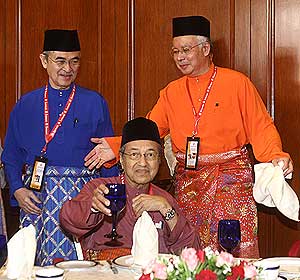 The one system is reliant on ancillary props such as a cabinet, a ruling party, and a civil service, each a power base in itself; the other system is invested with powers which, if charismatically employed, can transcend restraining mechanisms.
Mahathir composed himself presidentially, imperially so at times, within what was a prime ministerial system; his predecessor, Hussein Onn, had a collegial style that fitted the prime ministerial mould of governance.
Najib appears to be intimating that he could be presidential, but so far he has shown that he lacks the imagination and boldness to transcend the restraints of the prime ministerial system.
Leadership styles are as varied as the personalities who assume the mantle. In other words, to each his own style.
Only one thing is certain: all need the touch of the alchemist to turn the base conditions of their inherited and current situations into the gold of successful tenures.
TERENCE NETTO has been a journalist for close on four decades. He likes the occupation because it puts him in contact with the eminent without being under the necessity to admire them. It is the ideal occupation for a temperament that finds power fascinating and its exercise abhorrent.


