




Toh Chin Chye and what might have been
With the death of Dr Toh Chin Chye, a former chairman of the PAP (People’s Action Party) and deputy prime minister of Singapore, the last member of the Malaya-born complement of leaders who led the island republic in the fraught larval stages of its development into today’s economic cynosure is gone from the scene.
Three other signal members of the band – Sri Lanka-born but Seremban-sired S Rajaretnam, and the Malacca-born Devan Nair and Goh Keng Swee – had already predeceased Toh who hailed from Batu Gajah and schooled in Taiping.
No doubt about it, all four were members of a formidable quartet of leaders any fledgling nation would be grateful to have harnessed for its engine room...
With the death of Dr Toh Chin Chye, a former chairperson of the PAP (People’s Action Party) and deputy prime minister of Singapore, the last member of the Malaya-born complement of leaders who led the island republic in the fraught larval stages of its development into today’s economic cynosure is gone from the scene.
Three other signal members of the band – Sri Lanka-born but Seremban-sired S Rajaretnam, and the Malacca-born Devan Nair and Goh Keng Swee – had already predeceased Toh who hailed from Batu Gajah and was schooled in Taiping.
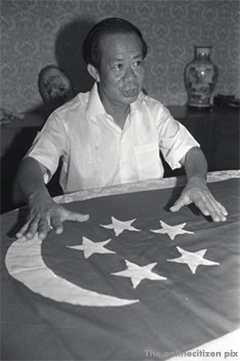 No doubt about it, all four were members of a formidable quartet of leaders any fledgling nation would be grateful to have harnessed for its engine room.
Almost all of them first made their acquaintance in the Malayan Forum, an informal gathering of politically-conscious Malayans and Singaporeans in London where they were studying for their degrees in the late 1940s.
Those encounters which included people like Abdul Razak Hussein, who would go on to be prime minister of Malaysia, were the genesis of the non-communist intelligentsia seeking to expedite Britain’s relinquishment of its role as colonial masters of Malaya and Singapore.
At the time when these young men were restive with anti-colonial sentiments, the left-wing movement in Malaya and Singapore were thought to be the stronger and more organised force among local clamourers for independence.
Also, Malaya and Singapore were not readily thought of as distinct geographic entities; the Johor Strait not really occupying the aura of the English Channel as a cultural and historic separator between England and Europe.
Singapore was regarded as an entreport with the Malay Peninsula as its hinterland, indissolubly linked.
It did not make a difference on which side of the Johor causeway you were born; you were Malayan, and if English-educated and a witness to Britain’s military defeat, albeit temporary, at the hands of the Japanese in 1941, you would want the returning colonial overlord to put a date on his quitting.
Egalitarian ideals
What made Toh Chin Chye rather different in this English-educated, and vaguely Fabian socialistic cohort that were studying in England in the late 1940s, was that he appeared to be the more amenable of this non-Malay leadership elite to the argument that the Malays of the Peninsula would require a longer time frame to come into their own educationally and economically.
Sure, he was devoted to the egalitarian ideals that infused others of the Malayan-born complement who went on to forge the PAP, but he had a better feel for the cultural and historic differences that separated Malay from non-Malay, and the demeanour and discretion to go with that appreciation.
That would have rendered him a better interlocutor for the PAP’s concerns in the delicate negotiations with Tunku Abdul Rahman on the vexed question of Singapore’s merger with Malaya in 1963 that issued in its conflicted separation two years later.
Hindsight may be an unrespectable tool, but there are times when its application is inescapable. High political misjudgment is the thread running through the brief history of the two states' merger.
If objectivity can be brought to a question long drenched in opinionated emotion, it might be commonly agreed that Lee Kuan Yew who did the negotiating with the courtly Tunku was temperamentally ill-equipped for the task.
An in-house critic
Since separation in 1965, Singapore, driven by the brains trust whose spawning grounds was the Malayan Forum, had gone on to become an economic powerhouse while Malaysia’s trajectory has only flirted with economic success, while its social barometers are anything but comforting.
Indeed it is sterile to speculate on the what might have been, but if the steely but mild-mannered physiologist who was educated in Taiping was the main interface between PAP and the Tunku, the history of these parts might have been different.
Toh’s post-separation career trajectory was not as bright as others of the Malayan-born PAP claque, but he did not become a dissident and then an outcast like Devan Nair. He preferred to be an in-house critic.
He was known to have doubts about the use of the Internal Security Act (ISA) against local opposition which only confirmed his innate decency.
It is not known if he had committed his recollections to a diary because its posthumous publication would be an aid to disentangling the Malaysia-Singapore merger story.
This would be grist for the theory that alternative destinies would have happened but for some interlocutors.
TERENCE NETTO has been a journalist for close on four decades. He likes the occupation because it puts him in contact with the eminent without being under the necessity to admire them. It is the ideal occupation for a temperament that finds power fascinating and its exercise abhorrent.


Report this comment
Are you sure you want to delete this comment?
This action cannot be undone.