




The new Chinese dilemma, or MCA's?
Leaders from BN component parties squared off with DAP in a debate over the issue of the so-called ‘new Chinese dilemma’ at the afternoon conference ‘Malaysian Chinese at the Political Crossroads’ today.
Leaders from BN component parties squared off with DAP in a debate over the issue of the so-called ‘new Chinese dilemma’ at the afternoon conference ‘Malaysian Chinese at the Political Crossroads’ today.
 MCA vice-president Gan Peng Sieu (
photo, right
) got the ball rolling arguing that the current socio-political landscape is heading towards a two-race system, rather than a two-party system.
MCA vice-president Gan Peng Sieu (
photo, right
) got the ball rolling arguing that the current socio-political landscape is heading towards a two-race system, rather than a two-party system.
Hence, he said, the Chinese showing a strong inclination towards the opposition will cause the community to be “grossly under-represented in the government.”
“For example, the Chinese in Sarawak constitute 30 percent of the population, but there is only one representative in the state government.
“Is that what we want?” he said at one of the forums for the day titled ‘The new Chinese dilemma, should the Chinese have a strong representation in the government or be a strong opposition in the two-party system’.
 Gan backed his argument with data showing that of the 166 parliamentary seats in Malaysia, 116 are dominated by a certain ethnic group.
Hence, he argued, voters will always cast their ballots along racial lines.
“So Cheras will forever be Cheras, and Teresa Kok will need the 90 percent Chinese votes in her Seputeh constituency to deliver her (the seat),” he said, adding that the same goes for the Malay-dominated areas in Kedah and Kelantan.
The MCA senator contended that the situation is unlikely to change in the near future because of the distinctive race identity preservation and the reservation of land to certain ethnic groups.
“Any change for this country must not be driven by one community.
“If the change is only driven by the Chinese, it is going to create a two-race system at the expense of the Chinese,” he said, calling it the new “Chinese dilemma”.
Gan’s theory was however not shared by his BN partner party Gerakan, who labeled the current political scenario as “two multiracial coalition systems”.
‘The Malaysian is the minority’
Gerakan Youth secretary-general Dominic Lau Hoe Chai, while stressing that his party is multiracial, claimed that the Chinese, or the general public as a whole, only wants a clean and transparent government.
 “You said there is a dilemma because you look at it from a racial perspective. If you throw out that perception, there is no dilemma,” Lau told the 350-strong crowd.
He then cited the example of the 1986 and 1990 general elections, where the Chinese voted in a landslide favouring the opposition.
“But when the opposition could not deliver, they shifted back to BN in the 1995 general election,” he said.
Lau also lamented that the true minority ethnic group in the nation “is indeed the Malaysian”.
He hoped voters can begin to break the racial segmentisation and vote for “anyone capable, no matter if they are from BN or Pakatan, in the next election”.
Who is at the crossroad?
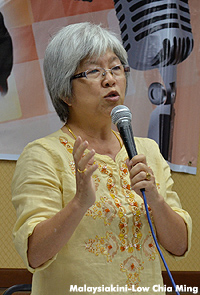
Meanwhile DAP deputy secretary-general Chong Eng continued the session by brushing aside the idea of the existence of a Chinese dilemma.
“You said there is a new Chinese dilemma. But after so long, we did not even know what is the dilemma you are talking about,” she said.
 “If there is a new dilemma, what is the old one?” she asked.
She stressed that the Chinese are neither in a dilemma nor at a crossroad, and they have been consistent in their demands, which is for a just government.
Besides the Chinese, she said, all the urban voters, who have better access to information, are clamouring for change.
She added that the political tsunami in 2008 has also swept away the often negligent attitude of the BN government.
“Don’t you think they are more sensitive now? The recognition of the Chinese independent school certificate was never possible in the past, but (BN) is now seems to be working towards it,” she said.
“This is because they realise that after the two-party system (came to be), every vote is now valuable.”
“So a two-party system is a solution, not a dilemma,” the Bukit Mertajam MP ( above ) said.
Chong added that it was MCA instead that was at a political crossroads.
“At this crossroad, MCA has to decide whether they are going to represent the Chinese truly and deliver what they want, or continue to be with BN,” she said.


Are you sure you want to delete this comment?
This action cannot be undone.