




Manifestation of God: Any ruler, not royalty alone
Former Perlis mufti Mohd Asri Zainul Abidin rebutted claims citing narratives about Prophet Muhammad that “the kings are manifestations of God on earth”.
Former Perlis mufti Mohd Asri Zainul Abidin rebutted claims citing narratives about Prophet Muhammad that "the kings are manifestations of God on earth".
Mohd Asri argued that meaning of the hadith or prophet's saying could be extended to any ruler, not royalty alone.
"I heard some are more outspoken and use the original wordings of the hadith - al-sultan is bayangan Allah (Allah’s manifestation) on earth - to refer to a sultan of his choice.
"Some seem to want to revive Malay feudalism with the hadith .
"I jibed at those who are fond of using that hadith by saying: the king that becomes Allah ’s manifestation, is it the king of Jordan or the king of Saudi Arabia? Or perhaps the king of Morocco?
"Or since it was too general, maybe it could be used for the Siamese king?" he wrote in a Malay language commentary published on Malaysiakini today.
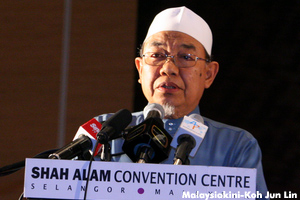 During the launch of the pro-Islam NGO Jati last Tuesday, Perak mufti
Harussani Zakaria
urged Malays to defend the royalty, saying:
During the launch of the pro-Islam NGO Jati last Tuesday, Perak mufti
Harussani Zakaria
urged Malays to defend the royalty, saying:
"The Prophet had said that kings are the manifestation of God on earth. Not on a single occasion, but in several tellings."
However, Mohd Asri said: “Actually there are many stories surrounding this hadith. Some are false, some are weak, some are acceptable or maybe approaching being considered ‘authentic’.”
In the Malaysian context
In his article titled 'Since when did the sultan became God’s manifestation?', Mohd Asri said that the term ‘al-sultan’ includes all rulers, regardless of their titles. Otherwise, the caliphs who succeeded the prophet would have called themselves sultan.
“Meaning that in the Malaysian context, the prime minister is also Allah’s manifestation on earth. So are the presidents of Egypt, Libya, and so on.”
However, he said, being “Allah’s manifestation” does not mean those in power are sacred to the point of being beyond question.
“Because, how many people had been installed as caliph (Allah’s representative), but did the opposite? Are we to defend him because he is the caliph?”
Mohd Asri quoted an alternative interpretation of the hadith, suggesting that bayangan (shadow) ought to mean ‘protection’.
“Because he (the ruler) protects people from harm, like a shadow that protects one from the sun’s heat,” he said.
He also cautioned against using religion as a political tool, because it would come at a cost to the religion itself.
“Manifestation of God can be misinterpreted, as in the history of many nations. As a result, a ruler’s greed and oppression becomes legitimised in the name of God,” he added.


Are you sure you want to delete this comment?
This action cannot be undone.