




Minister defends 1M'sia logo on subsidised goods
The Domestic Trade, Cooperatives and Consumerism Ministry says that manufacturers of subsidised goods had agreed to carry the 1Malaysia logo on their products as part of their corporate social responsibility (CSR).
The Domestic Trade, Cooperatives and Consumerism Ministry says that manufacturers of subsidised goods had agreed to carry the 1Malaysia logo on their products as part of their corporate social responsibility (CSR).
In a written reply to Batu MP Tian Chua, minister Ismail Sabri Yaakob said the ministry had struck the agreement on the matter with manufacturer after discussions.
He said they had agreed to do so because they considered helping the federal government inform the public about subsidised goods was a CSR effort.
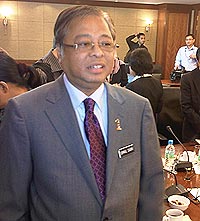 "Thus, allegations that the government forced manufacturers to use the 1Malaysia logo are untrue," said Ismail (
left
).
"Thus, allegations that the government forced manufacturers to use the 1Malaysia logo are untrue," said Ismail (
left
).
He added that the 1Malaysia logo aims to create awareness about subsidies to help reduce their abuse for profit.
He was responding to Chua's question on the rationale behind the move and whether subsidies would be removed if the manufacturers did not comply.
Sabri ignored the second part of Chua's question.
After the new ruling was announced in February, critics pointed out that this was a form of abuse because 1Malaysia was a BN propaganda tool .
RM40m for 85 KR1M outlets
To another question posed by Chua, Sabri revealed that the federal government will spend up to RM40 million by the year end, for the establishment of 85 Kedai Rakyat 1Malaysia (KR1M) outlets.
The KR1M outlets, the brainchild of Prime Minister Najib Abdul Razak, sells generic household products, which are supposed to be cheaper than brand names found in hypermarkets.
Najib said that the purpose of this chain was to provide a form of relief for inflation stricken consumers.
However, critics alleged that tax payer funds used for the project ultimately benefits retail giant Mydin Mohamed Holdings Bhd, which runs the chains nationwide.
Others have pointed out that a number of products offered by KR1M were inferior , tainted or more expensive than hypermarket prices.
At one point, 13 KR1M products were removed from shelves after complaints were made while the Health Ministry has admitted that some products were problematic.


