




'We're best among the best' in fighting political graft
Malaysian Anti-Corruption Commission (MACC) deputy commissioner (operations) Mohd Shukri Abdull claims that Malaysia is among the top countries when it comes to charging politicians with corruption.
Malaysian Anti-Corruption Commission (MACC) deputy commissioner (operations) Mohd Shukri Abdull claims that Malaysia is among the top countries when it comes to charging politicians with corruption.
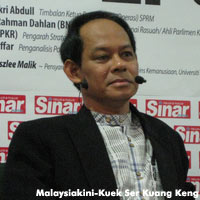 "We are the best among the best," Shukri (
left
) declared at a public forum in Shah Alam today.
"We are the best among the best," Shukri (
left
) declared at a public forum in Shah Alam today.
He said statistics since 1960s showed that the number of politicians charged with corruption in Malaysia was higher than that in Singapore and Hong Kong, which are renowned for their anti-graft efforts.
However, Shukri did not back his statement with more details or figures.
On the controversy of ruling parties using government machinery during election campaign, the senior official who has 27 years’ experience in combating graft, said it is inappropriate, and there should be a caretaker government once Parliament has been dissolved.
“But currently there is no complete guidelines (on this issue). It should be brought up to the government,” he said.
Sharing the same view, PKR strategy director Rafizi Ramli, another speaker at the forum, added that the authority should also make it clear whether election promises made by both sides of the political divide are categorised as bribery.
The forum titled ‘Political Bribery: Reality or Perception’ organised by Malay daily Sinar Harian , also invited two other speakers - BN’s Kota Belud MP Abdul Rahman Dahlan and political analyst Chandra Muzaffar.
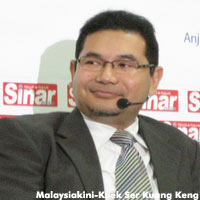 The MACC number two appealed to Rafizi (
right
), who was instrumental in exposing the National Feedlot Corporation (NFC) scandal, not to expose corruption allegations to public and media before the MACC secures enough evidence.
The MACC number two appealed to Rafizi (
right
), who was instrumental in exposing the National Feedlot Corporation (NFC) scandal, not to expose corruption allegations to public and media before the MACC secures enough evidence.
He said the opposition’s actions to politicise corruption allegations by making public statements before lodging a report and bringing media along when lodging report are not encouraged because they will “destroy the case”.
“The impact is like when you are beating drums as you enter the forest to hunt birds. Of course the birds will flee, not only birds, even elephants will run away!”
Hard to secure witnesses
Shukri explained that documentation proof is easier to secure but witnesses, who make up 70 to 80 percent of evidence, will conspire among themselves to cover the case once they are alerted by media reports.
“Many cases were destroyed due to prior expose. It makes it hard to get the cooperation of witnesses... some witnesses destroy the documents after the allegation is exposed,” he said.
Hence, Shukri advised political parties to lodge the report with the MACC discreetly and give them some time to secure the necessary evidence before exposing the allegations to the public.
However, Rafizi refuted that it is now the era of “people activism” which the society is willing to play a proactive roll in assisting the authority to investigate corruption, hence the MACC should change its approach in dealing with the whistleblower.
“It is not that hard to investigate. I have become a private investigator (due to the NFC scandal). The time has changed, we are now short of hands to investigate all the tip-offs received.
“I'm willing to work part-time for MACC if I’m promised that I can investigate the high-profile cases involving ministers,” he quipped.
Abdul Rahman commented that corruption allegations have become Pakatan Rakyat’s greatest weapon to attack BN because the opposition could not outshine the ruling coalition in terms of economic policy and governance.
He noticed that the opposition has been closing one eye when it comes to corruption allegations against its own members.
For example, Abdul Rahman said, during PKR de facto leader Anwar Ibrahim’s 16 years in BN government, DAP leaders had been accusing him of corruption but they become silent after Anwar joined the opposition.
He also stressed that Prime Minister Najib Abdul Razak’s political will to combat graft is evident in his decision to link the government’s key performance index with the international Corruption Perception Index, the first nation in the world to do so.


Are you sure you want to delete this comment?
This action cannot be undone.