




Pakatan leader hews a consistent line
COMMENT At the rate he’s going, the only violence you can expect from Anwar Ibrahim and his Pakatan Rakyat cohort, should the opposition coalition lose the general election, is the force with which books would be grappled off bookstore shelves to see where they had gone wrong in their judgement of voter preferences.
Begging Dr Mahathir Mohamad’s and Rais Yatim’s pardon, after the Pakatan crowd has digested the relevant stuff, they are not likely to use the tomes as projectiles to pelt the police on the streets to demonstrate their frustration over their electoral defeat.
COMMENT At the rate he’s going, the only violence you can expect from Anwar Ibrahim and his Pakatan Rakyat cohort, should the opposition coalition lose the general election, is the force with which books would be grappled off bookstore shelves to see where they had gone wrong in their judgement of voter preferences.
Begging Dr Mahathir Mohamad’s and Rais Yatim’s pardon, after the Pakatan crowd has digested the relevant stuff, they are not likely to use the tomes as projectiles to pelt the police on the streets to demonstrate their frustration over their electoral defeat.
Though both the former prime minister and current information minister have written books and dissertations on subjects of national concern, their theories these days have only a tenuous link to the intellection that may have prompted their threadbare efforts of the past.
 Rais has already deprecated as an “academic exercise” his doctoral thesis on constitutionalism in Malaysia and how Umno-BN has perverted it; Mahathir, a good four decades after penning ‘The Malay Dilemma’, is still undecided whether heredity or culture is the more decisive factor in determining the progress of peoples, having given the former factor greater weight in his initially banned book that drove his career to its prime ministerial culmination.
No comparable repudiation or ideational prevarication has marked the intellectual odyssey of the opposition leader who last night held forth before the Foreign Correspondents Club of Malaysia (FCCM) in a manner that exposed the consistent lines of development in his thought which in the middle of his seventh decade (Anwar will be 65 in August) is sporting the stately dignity of an ocean liner, albeit weather-beaten and battered, coming in to port.
Whether it gets to dock at Putrajaya - the problems and pitfalls facing that endeavour at the coming general election - were the focus of questions from 70-odd correspondents, foreign diplomats and guests who turned up to hear him.
The notebook and recorder crowd, as is their wont, were intent on the newsy angles, to wit, what Anwar felt about the influence of Mahathir on Malay voters, when the election would be held, whether there would be violence in the vote’s aftermath, and so on and so forth.
While furnishing predictable replies to the straightforward questions and fending off the opaque ones with aplomb, the leader of the band of Putrajaya presumptives secreted, in the folds of his narrative, the philosophical underpinnings of his worldview.
Democratic revolution
Frequent listeners to his spiel will have noted the consistency of the philosophical tropes that compose the warp and woof of his weltanschauung.
Last Saturday in Penang, he elaborated his concept of development , citing Amartya Sen’s five parameters - political freedoms, economic amenities, social opportunities, transparency guarantees and protective security - the Nobel laureate said must be achieved for development to have lasting impact on society.
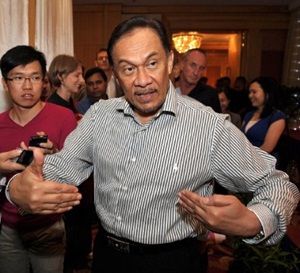 Along the way, he referenced Spanish philosopher Ortega y Gasset’s famed warning on the perils of underestimating the intelligence of the masses, in response to questions about what he would do if the people wanted to probe the spectacular financial and corruption scandals that had occurred on Mahathir’s prime ministerial watch, something the former PM was confident would be interred for good, never to be resurrected.
Last night, before the FCCM audience, he again adverted to Gasset’s admonition in the course of a response to a questioner’s speculation about Mahathir’s influence on the Malay mind, reiterating what he has often said in the past - the views of his one-time political patron were “obsolete” and “archaic.”
More importantly, however, was his response to an inquiry over how he felt about Mahathir’s and Umno’s unyielding attempt to tag him as pro-West and pro-America.
His reply showed his affinity for and eclectic grasp of the intellectual realm where, as the writer Matthew Arnold said, the best that has been thought and said is debated.
For that reason, Anwar said he had mandated that the younger set of leaders in his party, PKR, read and understand French philosopher Alexis de Tocqueville’s seminal work ‘Democracy in America’.
Written in 1835, the book as the product of the French noble’s nine-month journey through America, studying the new phenomenon of democracy.
As Tocqueville himself said, the country as object of his study “was only the frame, my picture was democracy.”
His findings, after talking to ordinary people, were that a democratic revolution was an irresistible fact - he predicted that it would sweep the world, though it took nearly two centuries before this could happen.
Anwar, who considers himself a democracy proselyte, holds that leaders who choose to stand in the way of its sweeping currents would be, as he told the FCCM yesterday, marooned on the banks of history rather than swimming in its currents.
TERENCE NETTO has been a journalist for close on four decades. He likes the occupation because it puts him in contact with the eminent without being under the necessity to admire them. It is the ideal occupation for a temperament that finds power fascinating and its exercise abhorrent.


