




Cyanide threat mere Pakatan propaganda, says Pahang MB
As all that glitters is not gold, the cyanide 'threat' to residents around Bukit Koman in Raub, brought by the Raub Australia Gold Mining (RAGM) plant, is merely an opposition political agenda.
As all that glitters is not gold, the cyanide 'threat' to residents around Bukit Koman in Raub, brought by the Raub Australia Gold Mining (RAGM) plant, is merely an opposition political agenda.
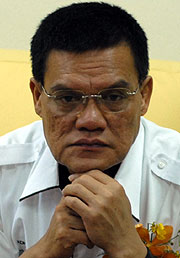 Elaborating, Menteri Besar Adnan Yaakob told the Pahang state assembly the cyanide threat to the residents was no longer an environmental issue.
Rather, it had become political and sensationalised by the opposition, he said.
"The opposition has purposely used the issue as their propaganda. They have learned this from their 'sifu' (teacher), Adolf Hitler (dictatorial leader of World War II Germany's Nazi Party), who believed that the people would believe a lie, if it was frequently repeated.
"The RAGM issue is being played by the opposition just like the Lynas issue. These have become their problems. Politics becomes so ugly when there's a 'ghost' who masterminds the opposition pact's agendas," noted Adnan.
 He was explaining the issue during question time at the sitting in Kuantan today.
Replying a supplementary question from Leong Ngah Ngah (DAP-Triang) on the cyanide threat alleged to have cause residents in Bukit Koman to suffer from skin rash, Adnan said the state government had carried out a survey on the matter, with cooperation from experts since 2009.
Earlier, Abdul Rahman Mohamad (BN-Padang Tengku) had also asked for detailed explanation and the exact number of residents who were suffering from skin rash, eye irritation and breathing problems, following the commencement of the RAGM operation.
To this, state local government, environment and health committee chairperson Hoh Khai Mun replied, a survey revealed that only 24.6 per cent of the residents suffered from such conditions.
"Generally, only 12 to 23 percent of them suffer from skin rash, headache (20 to 60 percent), watery eyes (four to 12 percent) and breathing problems (seven to 13 percent).
"The health ministry has adopted a specific approach by conducting a complete and systematic study to find the actual cause of the problems faced by the residents.
"A questionnaire is being prepared and will be distributed to the residents to obtain their direct feedback on the matter," he added.
- Bernama


