




Islamisation in national schools worries Hua Zong
The Federation of Chinese Associations Malaysia or Hua Zong is concerned about the increasing Islamisation in the bureaucracy of the primary and secondary national schools.
The Federation of Chinese Associations Malaysia or Hua Zong is concerned about the increasing Islamisation in the bureaucracy of the primary and secondary national schools.
 Speaking during a press conference today regarding the Malaysian Education Blueprint, its president Pheng Yin Huah said that they are concerned because the students are from different ethnic and religious backgrounds.
“The officials of the Education Ministry must recognise the multi-racial and multi-religious situation of Malaysia.
“Acceptance and respect for the different religious beliefs and ways of life of students from different ethnic groups are the necessary conditions for the national schools to unite the nation,” he said.
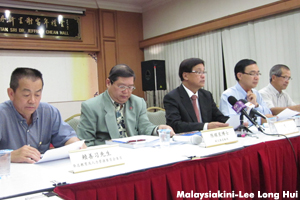 The deputy secretary-general of the federation, Chin Yew Sin, said that the blueprint, which was released last month, noted that some Moral Studies and Islamic Studies lessons will be conducted jointly, where there are shared values.
He said that this may influence the religious belief of the students of different religions.
“As we know, the values of Malays are based on Islam, but the values of Chinese are based on Confucianism.
“Confucianism is a universal theory without a religious element, so it won’t influence one’s belief. If other students want to learn about other religions, it may influence his or her own belief,” he said.
‘No clear plan for a multi-stream system’
Meanwhile, Pheng also said that the blueprint is promoting a single-stream education system without coming out with a clear development proposal of a multi-stream education system.
“The federation is against this view because the Chinese primary schools are more diversified compared to national primary schools. In terms of percentage, there is a higher ratio of bumiputras who study in Chinese primary schools than non-bumiputras in national primary schools.
“A multi-stream education system is not the factor which causes disunity, but it’s the biasness of policies and politicians who sensationalise the issue,” he added.
Pheng also urged the government to include the development of independent Chinese high schools into the blueprint.
He was unhappy over the government’s limit in the number of independent Chinese high schools to 60, but had on the other hand approved more than a hundred international schools.
“Hence, the federation hopes the government will amend the law in order not to restrain the development of independent Chinese high schools, and in the meantime bring the schools into the blueprint and allocate funding regularly,” he said.


Are you sure you want to delete this comment?
This action cannot be undone.