




Lawyer: Hudud pointless if police force corrupt
A forum on ‘Unity in Diversity’ in Penang veered towards the question of how the Syariah or hudud law can be implemented in a multiracial and multicultural society like Malaysia without disrupting the existing social order.
A forum on ‘Unity in Diversity’ in Penang veered towards the question of how the Syariah or hudud law can be implemented in a multiracial and multicultural society like Malaysia without disrupting the existing social order.
Human rights lawyer Fadiah Nadwa Fikri said it was pointless to have such laws if the police are “unprofessional, corrupt and was merely protecting” the interests of the ruling government.
 Fadiah (
left
), the former coordinator of Lawyers for Liberty, said several laws dealing with crime like the Penal Code and Criminal Procedure Code currently exist but are not implemented properly due to corruption.
Fadiah (
left
), the former coordinator of Lawyers for Liberty, said several laws dealing with crime like the Penal Code and Criminal Procedure Code currently exist but are not implemented properly due to corruption.
“Here, what we need is a body to monitor and probe the police, we do not need hudud law,” she told the 30-odd participants in the forum organised by the Islamic Renaissance Front, Liberty Centre Penang and Project Dialogue on Saturday.
Fadiah was accompanied on the panel by Aliran treasurer and blogger Anil Netto and Penang Institute senior executive Steven Sim, while Ahmad Fuad Rahmat chaired the three-hour session.
Fadiah, a lawyer for Suaram, said that conviction under the system was extremely difficult as the burden of proof to establish a crime had been set too high.
Even during the Prophet’s (pbuh) time, she added, there was no actual conviction under the hudud law, and if implemented now, it may disrupt the existing order of the country’s diverse society.
“It is better to advocate for police reforms and to demand government accountability than to press for the implementation of the Islamic law.”
‘1Malaysia an artificial construct’
Meanwhile, Anil advised citizens to question whenever there are calls to unity, like Prime Minister Najib Razak’s 1Malaysia slogan, to find out if it would benefit them.
“When I hear the 1Malaysia call, it makes me cringe because it appears to be an artificial construct,” said the freelance journalist and social activist.
“We should always ask what does the call for unity stand for, is it for a universal value? What does 1Malaysia stand for? Does it stand for something that benefits the people or not?” he queried.
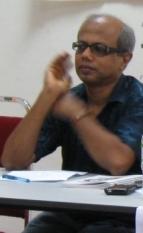 Anil (
right
) agreed that dictators use diversity as a tool to advance their interests, despite an outward portrayal of unity, citing the recent
‘wedding of the year’
, which attracted a crowd of about 130,000.
Anil (
right
) agreed that dictators use diversity as a tool to advance their interests, despite an outward portrayal of unity, citing the recent
‘wedding of the year’
, which attracted a crowd of about 130,000.
“You can see how multinational the crowd is, you will see a fantastic picture of how well they are integrated at the top level but at the bottom, we are kept divided,” he said.
Government critics often decry that there are forces trying to keep Malaysians divided by raising issues of Malay supremacy, of Christians wanting to form a Christian state or Muslims insisting on hudud law.
“People are being kept divided while, for example, about one trillion ringgit of the country’s money is being siphoned off,” he explained, referring to a global financial report on the matter.
‘Unity in intolerance’
Sim, who is a Seberang Perai municipal councillor, said that there are many common features that can unite people who are from diverse backgrounds, despite ongoing attempts to divide them.
He added that there are opportunities for solidarity among diverse groups in the struggle for rights or justice, although these causes may be born out of “intolerance”.
“We can be united by our common intolerance against oppression. Simple unity and more tolerance just will not do any longer,” said the DAP member from the Bukit Mertajam division.
“We are a society fearful of differences. This, if you think carefully, is a consistent trait in authoritarian societies,” he added.
“We need to appreciate the fact that there are more differences within us than between us and not let our government force us into false competing categories like bumiputera and non-bumiputera.”


Are you sure you want to delete this comment?
This action cannot be undone.