




Film seeks to overcome May 13 trauma, says director
Controversial film 'Tanda Putera' director Shuhaimi Baba says she made the film in order to help the nation overcome the "trauma" of the May 13, 1969, racial riots.
Controversial film 'Tanda Putera' director Shuhaimi Baba says she made the film in order to help the nation overcome the "trauma" of the May 13, 1969, racial riots.
Shuhaimi said she had hoped the film would spur discussions about the nation's "dark past", regardless of whether people were ready to face it.
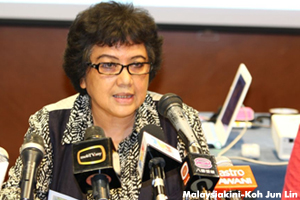 "If we do not discuss our history, we will not be able to overcome our trauma...I feel that, ready or not, we must discuss it.
"I made this film with the hope that after watching the film, people will discuss it, not only among Malays but also with the other races, to understand what happened so that it will not recur.
"Our country has a dark past, as do other countries. (But) are we going to sweep it under the carpet and say 'don't talk about our dark past'? If we do, we will never know what happened," she added.
Responding to a question at a forum to discuss the film at Universiti Teknologi Malaysia (UiTM), Shuhaimi said that she, too, was willing to take part in such discussions on this dark past.
She was even willing to show documents to back her version of what had happened, and discuss the causes of the riots with historians who "side with the Chinese".
However, Shuhaimi did not specify who these historians were or how they had "sided with the Chinese", when responding to a question on whether the people were ready to view the film, particularly a racial riot scene.
Why are we so touchy?
A snippet of the scene was shown during the discussion on the film held at the UiTM's Shah Alam campus last night.
Shuhaimi also questioned why this was an issue, and not when political films from Hollywood, Singapore and Indonesia are screened.
"When it comes to our film, we ask if we are ready to watch it. This is something we are facing.We have our own psychological problems," she said.
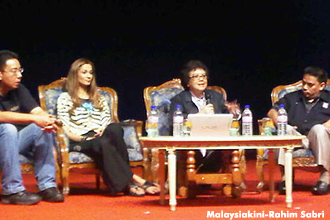 All the same, she admitted that some of the younger members of the audience were surprised and found it hard to believe that such a bloody incident had taken place.
"That is why we want people to learn about what happened. It happened so easily before. Today we hear lots of racist statements being uttered... We didn't know that such a thing could be triggered by mere word," she said.
However, she noted that the riots only made up five percent of the film.
People who do not watch films, she added, might find it difficult to appreciate historical films, especially those related to May 13, as compared to those regularly watch different genres.
It's a film, not a documentary
"So when they watch it, they will not view it from the creative licence perspective. When we create a film, it is made up. In the film, there is creative licence, there is fiction.
"So when we watch, watch it as a film. Ready or not, is not the question. You are watching a film, so treat it as that. If you treat it as a documentary, then things get complicated," Shuhaimi said.
She said those who viewed historical films, such as the assasinations of John F Kennedy and Martin Luther King, the Holocaust, or the Sino-Japanese war, were not as emotional.
"No one walked out of the cinema, nor did the Japanese hunt down the Chinese or the Chinese hunt down the Japanese (as a result). People who watch films are willing to accept anything...
"We are not able to watch this film (Tanda Putera) today as the person making the decision (whether to screen it) is not someone who watches films (regularly)," she said.
Shuhaimi said that about a year's worth of historical research was undertaken for the script, based on local and foreign documents and books.
She said that she had referred to several versions of the event to construct the scenes in the film, to ensure that it did not steer away from historical facts.
"We have to understand that there were several versions of what had happened at then (Selangor MB) Harun (Idris') house, we have to understand. If we read the official version, it's clear.
"But the Western reporters' versions are all lopsided... If we read that, we have to carefully make interpretations and decide which is the closest, according to our official history," Shuhaimi said.
The film, which is close to two hours long, among others depicts the relationship between two leaders - Abdul Razak Hussein and Dr Ismail Abdul Rahman - with the May 13 riots in the background.


