




Sarawak gov't, developers urged to learn Penan ways
Sarawak Land Development Minister James Masing has warned his colleagues in the government and large-scale developers they need a “human touch approach” in dealing with the Penan community as the eyes of the world are watching the government’s moves.
Sarawak Land Development Minister James Masing has warned his colleagues in the government and large-scale developers they need a “human touch approach” in dealing with the Penan community as the eyes of the world are watching the government’s moves.
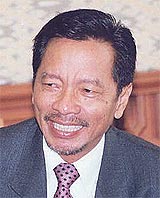 “If we approach big development projects affecting our people in the future in this manner, I am confident that we will be successful and (will be left) with less problems.
“That kind of development approach, with human touch, is the way forward for Sarawak,” Masing ( right ) said in his winding-up speech on his ministry.
He said it was important to know the Penan’s cultural practices, especially that of the semi-nomadic Penan, which may be useful to the developers of projects that affect these communities.
“The semi-nomadic Penan are the darlings of the West. In the eyes of the West, they can do no wrong. We cannot influence nor change such perception, at least, not within a short time.
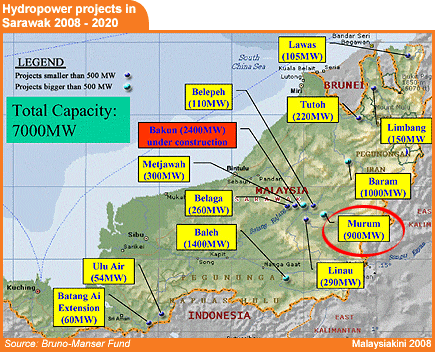
“Therefore, it is important then for us to understand this group of natives who have and will be affected by our development projects, especially in the construction of hydroelectric projects (HEP),” Masing said.
He said at the moment, 1,352 people were being affected by the construction of the Murum dam.
 “Small may be the number, but they are constantly hogging the print as well as the electronic media, and at times, this does not put us in a very good light among the international communities.”
Therefore, Masing suggested that it is perhaps time for developers and the Sarawak government to try to understand the Penan cultural nuances better so that they could have a better rapport with the native community.
‘Forests must remain intact’
While professing not to know all there is about the Penan culture, he cited one aspect that required attention, which is the community’s “agricultural practices, or the lack of it”.
Pointing out that the Penan are not sedentary farmers, he said: “They do not cultivate in the manner of the other native communities in Sarawak. They do not cut and clear large areas of forested land and then plant on them.
“But it does not mean that they do not need forested land and jungle for them to survive. Being hunters and gatherers the Penan need pristine jungles and forests to survive as they have done for generations.
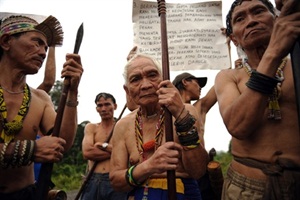 “From the forest they get their meat, from the river they get their fish and from the trees and plants they get their vegetables and jungle produce for their daily needs as well as for their economic necessities.
“They really take great care of their jungle supermarket”.
Thus, Masing said, the community needed the forest to remain intact to ensure their survival and that out of this necessity, the Penan have become the best jungle conservationists “the world has seen”.
“Thus, unnecessary felling of the jungle and trees is discouraged in the Penan community.
“The Penan do not clear the jungle to survive. They keep it intact to live. Consequently, the Penan do not possess land holdings as prescribed in our laws as they do not cultivate as we do.
“If we apply land holding in accordance with our laws, then the Penan will have none or very few lands to their names.
“We cannot, therefore, strictly use our laws as the benchmark to determine land holding among the semi-nomadic Penan community, including those residing in the Murum area”.
Choice of new or old lives
Therefore, Masing said, there was a need to use other benchmarks or criteria to compensate the Penans for their loss of lands and forests, which have kept them alive for generations.
 “However, it will be wrong to assume that the Penan want to be fossilised in time. It will be wrong to keep them in the forest forever. They, like the rest of us, want to move forward into the modern world; but to move at their own pace,” Masing added.
He believes that it will take at least one generation for the Penan to move from hunters and gatherers to the era of sedentary farming.
“This (Sarawak) government understands that it takes time for the mindset to shift from one era to the next and it is for this reason that, while schools and modern amenities are built for the affected Murum Penan to embrace modern living, about 30,000 hectares of forested land are reserved for the Penans within the Murum reservoir for the elder Penans to hunt and forage.
“They are given a choice to live a life which they want: the old or the new,” he said.


