




MCMC's defence of 4G licence to Syed Mokhtar 'defies logic'
Malaysian Communications and Multimedia Commission’s (MCMC) defence of the awarding of the biggest share of the 4G spectrum to business tycoon Syed Mokhtar Al-Bukhary's company Puncak Semangat Sdn Bhd defies all logic, says DAP.
Malaysian Communications and Multimedia Commission’s (MCMC) defence of the awarding of the biggest share of the 4G spectrum to business tycoon Syed Mokhtar Al-Bukhary's ( below ) company Puncak Semangat Sdn Bhd defies all logic, says DAP.
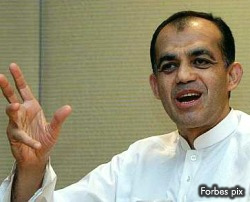 DAP national publicity secretary Tony Pua refuted MCMC chairperson Mohd Sharil Tarmizi's
argument
on Tuesday that the spectrum given to Puncak Semangat is to increase competition in the current market which has only eight players.
DAP national publicity secretary Tony Pua refuted MCMC chairperson Mohd Sharil Tarmizi's
argument
on Tuesday that the spectrum given to Puncak Semangat is to increase competition in the current market which has only eight players.
Pua, in a statement issued today, pointed out that by international standards, eight players are more than sufficient to generate a highly competitive environment.
Most other developed nations have far fewer than eight players in the industry, and yet remain highly competitive and innovative, he claimed.
“If the eight existing players are not competing by providing innovation today, then MCMC must be responsible for allowing the collusion between the eight parties.
“Under the Malaysian Communications and Multimedia Act (1998), MCMC is the authority to promote competition and bar collusion between telecommunication players”.
The Petaling Jaya Utara MP further explained that while ensuring competition in the industry, the manner in which the license and quota is awarded must also be questioned, as he claimed that some of the companies awarded with 3G and Wimax licenses by MCMC have failed miserably.
Decision against auction contravenes international practices
The other reason given by MCMC, that it has the power to take back the spectrum should players fail to meet their targets, does not give basis to an award of the largest share of the bandwidth to a completely new player in the industry, said Pua.
“Furthermore, a regulator's role is certainly not to play 'judge' in evaluating business plans, but to facilitate competition, prevent monopolistic practices and ensuring quality service provision”.
 On Tuesday, Sharil (
left
) also rejected the proposal to auction off the bandwidth on the ground that the highest bidder may not necessarily be the one with the best ideas.
On Tuesday, Sharil (
left
) also rejected the proposal to auction off the bandwidth on the ground that the highest bidder may not necessarily be the one with the best ideas.
The decision against auction, said Pua, is contrary to international best practices where both developed and developing countries have raised valuable income for the government while promoting a highly competitive telecommunications industry.
“UK, Germany, Sweden and even Thailand have held auctions, raising billions of ringgit in proceeds, while Singapore, Taiwan and Brazil are planning their auctions for next year”.
He elaborated that a company that is committed and believes it will trump the competition will be more than able to participate in an auction for the new spectrum.
“And should the company fail, the MCMC still has the power to withdraw its award while keeping the proceeds of the auction.
“Hence, under such circumstances, there is even greater incentive for the players to compete and innovate to ensure a successful business. This will at the same time benefit consumers.” he added.
MCMC playing ‘god’
Pua ( below ) urged MCMC to commit to Prime Minister Najib Abdul Razak's own slogan that "the era where the government knows best is over", and let the market play its part in determining the winner.
 “MCMC should instead focus on its role to prevent collusion between industry players, punish players who fail to provide quality services and create an even playing field for all parties in the industry.
“Otherwise, it becomes clear that MCMC is over-extending its regulatory role to play 'god' of the industry by deciding which company's profit to fatten, and ignoring the interests of the millions of telecommunication users in Malaysia”.
MCMC's recent decision to award 40MHz of bandwidth for the 4G long-term evolution (LTE) spectrum, the highest share among nine companies, to Puncak Semangat, a company said to have zero track record in the industry, has raised eyebrows .
The others winners of the spectrum are telecommunications companies Maxis Broadband Sdn Bhd, Digi Telecommunications Sdn Bhd, Celcom Axiata Bhd, U Mobile Sdn Bhd, Redtone Marketing Sdn Bhd, YTL Communications and Packet One Networks (M) Sdn Bhd, each only receiving 20MHz of bandwidth respectively.
Another company, Asiaspace Sdn Bhd, which holds a Wimax spectrum, was given 10MHz.


Are you sure you want to delete this comment?
This action cannot be undone.