




In haste for Putrajaya, Pakatan loses home ground
ANALYSIS A day after the 13th general election, results show that Pakatan Rakyat had wrested 22 parliamentary seats from BN, which should put it only eight seats short of federal power.
ANALYSIS A day after the 13th general election, results show that Pakatan Rakyat had wrested 22 parliamentary seats from BN, which should put it only eight seats short of federal power.
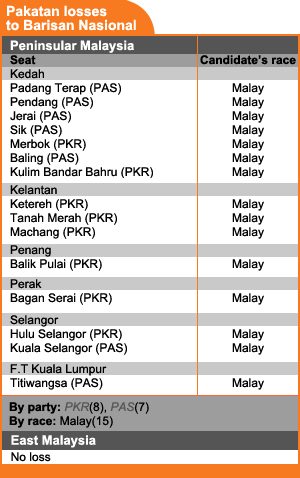 However, its strong focus on wresting parliamentary seats from BN's fixed deposit states saw the opposition coalition lose its grip on constituencies that it already won in the last general election.
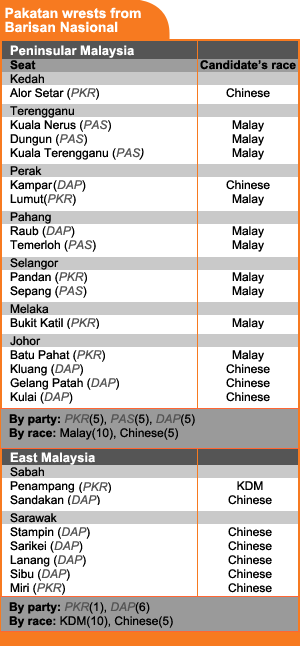
Pakatan's campaign in Johor, Sabah and Sarawak was somewhat successful as half of its 22 parliamentary seats gained were from these "BN fixed deposit" states.
Pakatan captured 15 parliamentary seats from BN in the peninsula and another seven from Sabah and Sarawak.
However, BN cancelled out Pakatan's gains in peninsula by also capturing 15 seats from the opposition coalition there, thus Pakatan only made a national net gain of seven seats, bringing the final results to 133 for BN and 89 for Pakatan.
Unlike in 2008 where there was a 'protest vote' against BN under then premier Abdullah Ahmad Badawi, Prime Minister Najib Abdul Razak had done much to regain lost ground for the ruling coalition.
 Despite his efforts, the ‘cancelling-out' of seats in the peninsula highlights the consolidation of the urban-rural divide in absence of a ‘protest factor' with PKR and PAS losing several semi-rural seats like Hulu Selangor,
Kuala Selangor
and
Bagan Serai
, but picked up several semi-urban seats such as
Sepang
,
Pandan
and
Bukit Katil
.
Despite his efforts, the ‘cancelling-out' of seats in the peninsula highlights the consolidation of the urban-rural divide in absence of a ‘protest factor' with PKR and PAS losing several semi-rural seats like Hulu Selangor,
Kuala Selangor
and
Bagan Serai
, but picked up several semi-urban seats such as
Sepang
,
Pandan
and
Bukit Katil
.
Pakatan held on to most of its urban and semi-urban seats and in Kuala Lumpur, still controlled 10 of 12 parliamentary seats, with the exception of Titiwangsa which fell back to BN.
Another significant point is the "Kedah factor" which contributed to five of the seven total seats lost by PAS.
PAS' former Kedah Menteri Besar Azizan Abdul Razak's lacklustre performance and infighting - on top of the allure of a young menteri besar in the form of Mukhriz Mahathir from BN - saw the Islamist party swept out at both the state and parliamentary levels.
This is on top of other smaller localised factors such as in Balik Pulau where PKR had infighting and questions over PKR's record in Kelantan where it lost three parliamentary seats there.
In total, PAS lost seven parliamentary seats and PKR lost eight parliamentary seats in the peninsula, while DAP succeeded in retaining all of their seats that was won in 2008.
A Chinese opposition?
Another notable observation in this general election is the strong swing of Chinese voters against BN, which saw BN chief Najib describing this as a "Chinese Tsunami".
 This has led MCA president Chua Soi Lek (
left
) to declare the results of the general election as the beginning of a two-race system where the government is made up of Malays and the opposition are only Chinese.
This has led MCA president Chua Soi Lek (
left
) to declare the results of the general election as the beginning of a two-race system where the government is made up of Malays and the opposition are only Chinese.
Ironically, the results showed almost half of the parliamentary seats that MCA lost to the opposition had been captured by Malay candidates fielded by PKR and DAP, namely in Lumut, Pandan and Raub.
Peninsula-based party MCA lost a total of eight parliamentary seats from the 15 it held in the last general election.
Contrary to MCA's race-mongering, with the 15 parliamentary seats Pakatan wrested from BN in the peninsula, Parliament will now see 10 new Malay and five new Chinese representatives from the opposition.
The gains made were also fairly balanced along party lines as DAP, PKR and PAS all captured five seats each.
The bulk of new Chinese parliamentarians in the opposition, in fact, came from Sabah and Sarawak at the expense of Sabah-based Liberal Democratic Party (LDP) and Upko, and more so for Sarawak-based SUPP.
With the seven parliamentary seats Pakatan wrested from BN in Sabah and Sarawak, Parliament will now see six Chinese and one Kadazandusun Murut opposition parliamentarian from East Malaysia.
However, PKR and PAS were very weak there, with the bulk of gains in Sabah and Sarawak made by DAP - which captured six - while PKR grabbed two and PAS had nothing to show.
Sabah and Sarawak have contributed to the rise of DAP as the largest opposition party with 38 seats, up from 28 in the last general election.
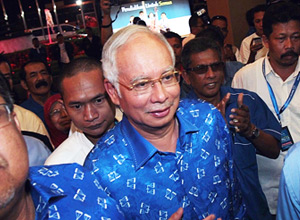 Najib (
left
), in his victory speech last night, was right in saying that there were some trends of racial polarisation in the voting process. However, the outcome in terms of overall representation remains almost status quo.
Najib (
left
), in his victory speech last night, was right in saying that there were some trends of racial polarisation in the voting process. However, the outcome in terms of overall representation remains almost status quo.
In fact, despite political peddling that Pakatan would threaten Malay power, preliminary observation shows that the overall Malay representation in Parliament has increased slightly as DAP's and PKR's Malay candidates won against MCA.
Preliminary data also shows that Pakatan Rakyat won the popular vote, but lost the general election with the most seats closely contested, suggesting a substantial - but uneven - swing among the Malay populace in favour of the opposition coalition.
PKR now controls 30 seats in Parliament, one less from the last general election as its losses were mitigated by new semi-urban seats, whereas PAS controls 21, two less than the last general election as the Kedah revolt had been offset by a Terengganu swing.


Are you sure you want to delete this comment?
This action cannot be undone.