




Gov't to study police discipline before looking at IPCMC
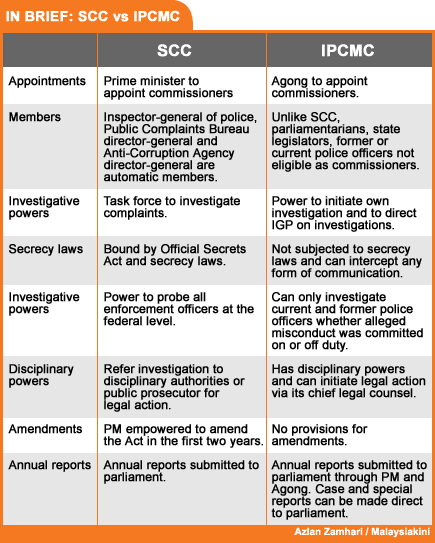
The government wants two weeks to study existing provisions for disciplinary cases within the police force before it can look into whether to implement the Independent Police Complaints and Misconduct Commission (IPCMC).
The government wants two weeks to study existing provisions for disciplinary cases within the police force before it can look into whether to implement the Independent Police Complaints and Misconduct Commission (IPCMC).
Deputy Home Minister Wan Junaidi Tuanku Jaafar said this was because there were some views that the internal police disciplinary board is better.
“There are claims that the present set-up is much better than what is recommended (in) the IPCMC.
 “If you look at the police force (worldwide), there are various ways of handing disciplinary (cases). In the United States, they have the internal affairs department...
“Let me have time to look at this. Give me a couple of weeks,” he told reporters today.
Wan Junaidi, whose legal background led Home Minister Ahmad Zahid Hamidi to get him to take the questions on the IPCMC, said the present system was inherited from the British.
Wan Junaidi said he has discussed this with Zahid on Sunday and met with inspector-general of police Khalid Abu Bakar on this yesterday.
He said the IGP and his team will brief the ministry of the existing preliminary measures taken to curb deaths in custody and a comparison will be made between this and the IPCMC.
Zahid: Are custodial deaths our fault?
Pressed further, Zahid stepped in to say that the government was not ruling out the implementation of the IPCMC but “new measures” were under way to address the problem of custodial deaths.
"The IGP is introducing a new department within the police force and I reckon he needs a positive response from NGOs and members of the public.
 "If everybody collaborates with the police... it will result in something long-term to resolve the problem," Zahid said.
He also urged the people to give "positive suggestions" instead of only "negative comments”, as the ministry was taking the matter seriously.
"Of course we are concerned. It happened during our time (in the ministry), in less than a month. But is this because of us?" Zahid asked.
He added that the poor public perception of the government is not the government’s fault but “the doing of those who don't like the government”.
“What they’ve done is to plant a deep culture of hatred, and the cost of improving this perception is high; not in monetary terms but in investments to attract public confidence,” he said.
Three detainees have died in police lock-ups in Negri Sembilan, Penang and in Kuala Lumpur in less than two weeks.
Study to abolish death for drug traffickers
Meanwhile, Wan Junaidi said the ministry was also studying whether to propose amending the Dangerous Drugs Act to abolish the death penalty for drug trafficking.
The minister and his deputy spoke to media after visiting the 1Malaysia Cure and Care clinic in Sungei Besi, Kuala Lumpur, which provides rehabilitation for drug addicts coming in on a voluntary basis.
Of the 10,801 people surveyed at the 11 clinics nationwide in 2010 to 2012, 65.1 percent of them were able to kick the habit.
Commending the National Anti-Drugs Agency, Zahid said he would look into proposing a collaborative, multi-agency task force to tackle the abuse of narcotic drugs, from smuggling, trafficking to rehabilitation.
He also suggested that all NGOs working in this area collaborate under one umbrella body.
"I am willing to assist, especially in sourcing funding, as I do not want them to be unable to continue with their activities because of financial constraints," Zahid added.
Related stories
Pakatan names IPCMC panel members


