




Rising prices, not religion, will break BN's hold
COMMENT Malaysia Day came and went, with the usual irony-deficient festivities. A float parade on dry land was drenched by rain in Kuching.
After half a century of broken promises, Sabah and Sarawak are still coupled to the Malaysian project. These two of the three poorest states in Malaysia (according to federal government statistics) keep drifting along, trailing in the wake of BN's sinking national economy.
COMMENT Malaysia Day came and went, with the usual irony-deficient festivities. A float parade on dry land was drenched by rain in Kuching.
After half a century of broken promises, Sabah and Sarawak are still coupled to the Malaysian project. These two of the three poorest states in Malaysia (according to federal government statistics) keep drifting along, trailing in the wake of BN's sinking national economy.
Umno's on-again, off-again ban on the use of the word "Allah" will make headlines again next month, with a Court of Appeal verdict, timed discreetly after the fireworks, tea, cakes, ices - and the perennial BN promises of development - of Malaysia Day.
If the ban on the use of "Allah" is reinstated, it might be expected to loosen the bonds between the large Christian populations in Sarawak and Sabah with Umno. But the likelihood is that rising prices, rather than religion, will one day cut Sabah and Sarawak loose of BN's hold.
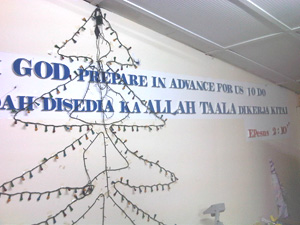 Christians
make up
44% of Sarawakians, and 32% of Sabahans.
Christians
make up
44% of Sarawakians, and 32% of Sabahans.
Most speak Malay and use the Bible in Malay, largely imported from Indonesia. The true proportion of Sabahan Christians is certain to be lower than these official statistics suggest, given the ongoing intake of Muslim Indonesian and Mindanao migrants, under an "IC-for-votes" scheme.
Voters among the 1.75 million Christians in Sabah and Sarawak helped return BN to power in the 13th general election, or GE13, in May.
Sarawakians voted enthusiastically for BN in the state assembly elections in 2011 too, despite scattered discontent over the confiscation of the copies of the Bible in the Malay language, and pre-election prayer meetings attended by thousands.
A church divided
Only a minority of Sarawakian and Sabahan Christians, mainly urban, voted for Pakatan in GE13, to show disgust with the confiscation of copies of the Bible, the Molotov cocktail attacks on churches following the High Court decision overturning the ban on New Year's Eve in 2009, calls by Perkasa (Umno's ventriloquist dummies) to burn the Bible, the stamping of serial numbers on copies of the Bible in Malay or the Al-Kitab, and a high-handed raid on a church in Damansara Utama in Selangor.
Christians in Sabah and Sarawak can be loosely grouped into urban and rural congregations. Urban Christians are generally better off, and better informed, than their rural counterparts.
Although many urban Dayak or KadazanDusunMurut Christians have families in rural areas, the flow of information about politics to the rural communities is, at best, sporadic.
This can be partly explained by the twin burdens of crushing poverty and terrible schools in rural communities.
Most urban middle-class Christians in Sabah and Sarawak have been considerably more enthusiastic in funnelling resources to build large churches , both in towns or villages, than in contributing to schools, clinics and basic utilities for poor rural communities.
A second reason for the absence of an electoral backlash is that the main Christian denominations - Sidang Injil Borneo (SIB), Anglicans, Catholics and Methodists - have tip-toed around concerns of religious persecution. Many Church leaders in these two states enjoy cosy relationships with ministers and have the honours and titles to prove this.
The outspoken intellectual landscape inhabited by progressive Peninsular Malaysian leaders, such as Bishop Paul Tan and Parit Buntar MP Mujahid Yusof Rawa, remains uncharted territory to the polite and gentle church leaders in Sabah and Sarawak.
Another explanation for the support for the Umno-dominated BN coalition is the common platitude that politics must be separated from religion, as exemplified by a conservative interpretation of a biblical verse: "Render unto Caesar what belongs to Caesar."
This same sentiment has been espoused by Sarawak's Chief Minister Abdul Taib Mahmud himself, for reasons of self-preservation.
Some would argue instead that separation of faith and the state is impossible: religious debate is an inseparable part of politics, just as spirituality is intrinsic to being human.
Debate, they say, must be governed by tolerance, dialogue, and a conscientious application of judgment, without considering self-interest, according to John Rawls' legal theory of "the veil of ignorance".
Political response if "Allah" ban is renewed
If the Court of Appeal restores the ban on the translation of "God" to "Allah" by non-Muslims, there will be no street demonstrations. We may see one or two acts of vandalism against mosques, similar to the fallout following the firebombing of churches.
These may be spontaneous outbursts of stupidity, or staged to make it appear like Christians are "challenging Islam".
The most likely outcome will be a frenzy of propaganda in the mainstream media, portraying Umno as a world champion of Islam, followed by a quiet word from Christian BN ministers to church leaders in Sabah and Sarawak that they will not have the Al-Kitab seized, as long as they are discreet.
Malays in Sabah and Sarawak, and the minority of non-Malays who have embraced Islam, including some Melanaus, Kedayans and Bisayas, are traditionally pious, courteous, and respectful of other faiths. They will not raise a fuss about the Al-Kitab.
Eventually, a few days before the next state assembly election due in 2015, the Umno president might concede the restricted use of the word "Allah" to non-Muslims again, as Prime Minister Najib Abdul Razak did in April 2011. But this scenario will be less likely in 2015 than in 2011, because Umno has lurched to the right.
Umno appears to be convinced that, thanks to malapportionment and gerrymandering, it can continue to rule solely by whipping up ethno-religious hatred among Muslim Malays in the peninsula and buying the votes of impoverished and isolated communities in Sabah and Sarawak.
Pakatan's response depends on crucial party elections in PAS in November. If the ulama faction, led by Harun Taib, gains ascendancy, Umno will thrive.
Alternatively, PAS may maintain its multicultural appeal and emphasis on a welfare state. The PKR under Anwar Ibrahim might then end its uncomfortable silence over Umno's "Allah" ban, and speak out strongly against using the name of "Allah" to score political points.
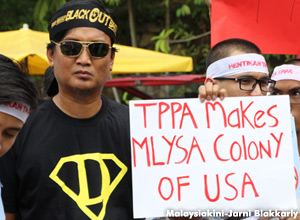 The PKR and the DAP may work harder to support native customary land rights in rural Sarawak, and build basic infrastructure, and Pakatan's "brand".
Rising prices and an impending economic downturn are signposted by a downgrading of our sovereign debt, subsidy cuts, a new Goods and Services Tax and a new healthcare funding scheme, riddled with leakages.
If the Trans-Pacific Partnership Agreement (TPPA) is agreed in secret, more jobs in small- and medium-scale enterprises will be lost.
Unemployment and inflation will cripple the BN in rural Sabah and Sarawak, as well as in Peninsular Malaysia. Umno might then be considering the merits of its ethno-religious baiting from the opposition benches.
KERUAH USIT is a human rights activist - ‘ anak Sarawak, bangsa Malaysia '. This weekly column is an effort to provide a voice for marginalised Malaysians. Keruah Usit can be contacted at keruah_usit@yahoo.com


Are you sure you want to delete this comment?
This action cannot be undone.