




'Rural and semi-urban areas no longer BN vote banks'
INTERVIEW Rural and semi-urban constituencies may no longer be secure vote banks for BN in future elections.
According to former deputy higher education minister Saifuddin Abdullah, this is because the "geopolitics" of these constituencies changes on polling day.
INTERVIEW Rural and semi-urban constituencies may no longer be secure vote banks for BN in future elections.
According to former deputy higher education minister Saifuddin Abdullah, this is because the "geopolitics" of these constituencies changes on polling day.
 In an interview with Malaysiakini, Saifuddin said constituencies in the rural and semi-urban areas could, on election day, turn into semi-urban and urban constituencies respectively due to "galvanised voters" - those who do not live in the constituency but return in great numbers to vote.
"Kelantan, geographically, is two-thirds rural. But during elections, it turns two-thirds semi-urban," said the former MP for Temerloh.
Saifuddin used his own constituency in Pahang and the Bachok constituency in Kelantan to illustrate his point.
"Temerloh becomes urban at the election because some 6,000 voters came back to vote. Actually, if you count my support among the Chinese who live in Temerloh itself, my support is good enough," he said.
Saifuddin lost his seat to PAS' Nasrudin Hassan by a majority of 1,070 votes at the May general election. Temerloh, which has 66,105 registered voters, is a Malay majority seat with 24 percent Chinese voters.
"In Bachok, where Awang Adek (Hussin) lost, he said it was because 16,000 voters came back to vote in the election. But Bachok is, by outline, a rural area," Saifuddin added.
PAS' Ahmad Marzuk Shaary defeated Umno's Awang Adek by a tissue-thin majority of 201 votes in the battle for the 99-percent Malay seat.
The 'democratic circle'
Saifuddin also revealed that the "democratic circle", which refers in large part to the civil society movement, was becoming more prominent than the bread-and-butter issues in the country.
"The first circle is the developmental circle, which is the circle where the people look at infrastructure, allocations and bread-and-butter issues.
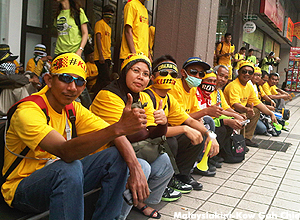 "The second circle is what I call the democratic circle. This circle concerns justice, human rights, and integrity," he said.
"The second circle, I first saw in 1999. People didn't notice it in 2004 because BN won by a landslide, but it was still growing. In 2008, it became even bigger. Now, I would say it is even bigger than the first circle."
This, Saifuddin said, explained why BN lost the popular vote despite winning more seats in the Dewan Rakyat.
"Even those from the first circle are beginning to ask questions. Now, when someone asks for a road, they might ask you, ‘why is it not done with open tender?'
"The BN is very good in addressing the developmental circle. But we are struggling to handle the second circle," he added.
DAP flag in Malay village
Saifuddin reiterated that he does not believe in the "Chinese tsunami" as propounded by Prime Minister Najib Abdul Razak.
"One of the popular discourses after the last general election was that Malaysians have become more polarised," he said.
"But if you go deeper and look at what actually happened during the campaign, it's not about race.
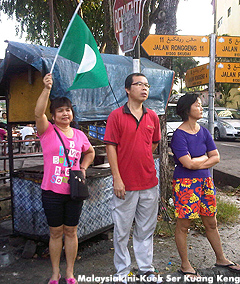 "In GE12, for the first time, I saw a non-Malay carrying a PAS flag. At that moment, as an Umno candidate, I smelled trouble. But as a democrat, I felt this as a good development.
"This time (GE13), I saw a DAP flag in a Malay village. Coming from Umno, I felt this was even more trouble. But as a democrat, again, I saw this as interesting," Saifuddin added.
He said the recent general election instead served as proof that Malaysians have become more colour blind.
"I'd strongly say that if you really care to look at the GE13 campaign, there was strong evidence that more and more Malaysians have become colour blind, and I stand by this argument. It may not be the discourse now, but this is what I have seen, then and now," he said.
He went to remind Umno leaders that they must start working for what would be right for the country, instead of being concerned only about winning elections.
"Even if the decisions are not popular and not favoured by the majority, you have to make them popular, and make them become the majority's decisions," Sasifuddin added.
This interview was jointly conducted by Ram Anand and Lee Way Loon.
THE SAIFUDDIN INTERVIEW
Part 1: Umno veered right after GE13, admits Saifuddin
Part 2: 'Umno leaders can't be selectively progressive'
Part 3: 'Rural and semi-urban areas no longer BN vote banks'


Report this comment
Are you sure you want to delete this comment?
This action cannot be undone.