




Kadir Jasin: Najib criticism is for country's good
Former New Straits Times Sdn Bhd group editor, Abdul Kadir Jasin, has defended his stinging criticisms on prime minister Najib Abdul Razak's management of the economy, saying one must be critical to ensure the country would have a good economy.
Former New Straits Times Sdn Bhd group editor Abdul Kadir Jasin has defended his stinging criticisms on Prime Minister Najib Abdul Razak's management of the economy, saying one must be critical to ensure the country would have a good economy.
He also reiterated his belief that the premier is not managing it well.
Abdul Kadir - in a blog posting yesterday - said besides Najib, he had in the past, criticised Abdullah Ahmad Badawi's administration when he drastically cut subsidies,.
He accused both of being extravagant in their expenditure and sloppy in the management of the country's finances.
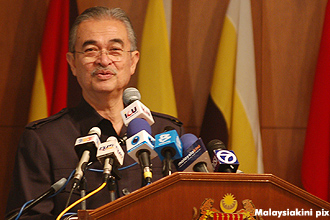 “They are not sensitive to the people. When the country was facing floods, Abdullah (
right
) was in Perth, Australia, to launch a restaurant. He returned to see the flood victims in Johor and then went back overseas.
“They are not sensitive to the people. When the country was facing floods, Abdullah (
right
) was in Perth, Australia, to launch a restaurant. He returned to see the flood victims in Johor and then went back overseas.
“Najib had continuously for two years chose to have his new year's vacation overseas and in this time, the country is faced with a reduction of subsidies simultaneously,” he said.
Abdul Kadir further asked whether it was wrong to criticise Najib and his expensive advisers worth “billions of ringgit”, and if he is considered a supreme king who cannot be touched or criticised.
The former top editor further asked whether Najib is a sacred being, who is free from making mistakes.
“Najib and his government should remember it was the people who chose them. It is not the people who promised and pledged not to raise prices, but rather, to reduce them.
“That person who promised not to raise prices is Najib and his election war room. Who is now breaking that promise?” he asked.
Price hikes
Abdul Kadir said it was not his job to give lessons on how to manage the economy, as the task is for the various ministries, departments, agencies and the PM's advisers.
He said his job is to give feedback and criticism and this should not be viewed as an attack on the administration.
“This is the problem when the society is not critical but seems extremely partisan. I have many times repeated that subsidies are not sustainable, a distortion to the economy which results in the people depending on the government.
“However, I question the government - especially the Abdullah and Najib administrations - in managing subsidies, in the monitoring and controlling of prices, the distribution of savings of subsidies and reducing the wasting of the country's finances,” he said.
He also pointed that the problem is not subsidies and a hike in prices alone, as the ringgit is depreciating against the US dollar and other major currencies, although Malaysia's economy is said to be more stable compared to the US.
Plans to sell assets
Abdul Kadir also pointed out reports of plans to sell the country's assets to resolve the financial problems faced by the government. He cited a summary from the Malaysia Economic Monitor, December 2013, that said:
“... the government reaffirmed its headline deficit target for 2013 (four percent of GDP vs 4.5 percent in 2012). This target will be achieved through additional tax revenues. Of the additional RM11.8 billion in revenues expected to be raised compared to budgeted estimates, RM7.4 billion originated from non-tax sources, including RM1.4 billion of proceeds from asset sales and RM4.2 billion from the securitisation of government mortgages...”
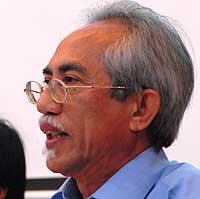 Abdul Kadir (
right
) said in summary the Najib administration is selling the country's assets and is charging the government's mortgages as security to supplement the budget deficit.
Abdul Kadir (
right
) said in summary the Najib administration is selling the country's assets and is charging the government's mortgages as security to supplement the budget deficit.
“Derivatives trading had led to the financial crisis of 2008 and 2009,” he warned.
Abdul Kadir said the country’s real problem is not the negative impact of the rationalisation of subsidies, as there are many issues which we should be more worried about.
“We must continue to ask, advise and criticise Najib. If there are people who feel this is wrong as they love the PM too much, then there is no purpose of having elections to choose a government.
"It is better to remove democracy and appoint the present government to administer indefinitely,” he added sarcastically.


Are you sure you want to delete this comment?
This action cannot be undone.