




Translation blunder may have led to Ultraman ban
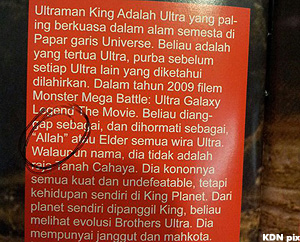
The use of the word ‘Allah’ in the recently banned ‘Ultraman The Ultra Power’ comic book appears to have been another faux pas involving Google’s translation service.
The use of the word ‘Allah’ in the recently banned ‘Ultraman The Ultra Power’ comic book appears to have been another faux pas involving Google ’s web translation service.
A photograph of the Malay version of the comic circulated online last night speculating the book has been banned because it described the character Ultraman King as ‘Allah’.
The Home Affairs Mnistry says the comic has been banned because it described the character Ultraman King as ‘Allah’.
A ministry official has also confirmed to Malaysiakini that a purported photograph of the comic with the offending word that has been circulated on social media since yesterday is authentic.
 The original text seems to be an excerpt of an English-language biography for the character
Ultraman King
(
right
) that was taken from an Ultraman fanpage.
It describes the character as being “considered to be, and respected as, the ‘God’ or Elder of all Ultra heroes”.
However, Google translates the word ‘God’ into ‘Allah’ when translating from English to Malay.
Instructing Google Translate to translate the first seven sentences in the fan page into Malay yields the exact same words as those in the comic, except that the Japanese characters do not appear in the latter.
Using a rival machine translation service, Bing Translator , yields a similar but slightly different result, but the word ‘Allah’ remains.
 The ban is also limited to the Malay translation of the book only, and is not a blanket ban on the popular 1960’s superhero, she added.
The ban comes in the midst of controversy over the use of ‘Allah’ for ‘God’ in the Malay language Bible, which certain conservative Muslim groups claim is an attempt to confuse and proselytise to Muslims.
Google Tranlsate strikes again
When contacted, Google Malaysia public relations chief Zeffri Yusof declined to comment on the matter, directing Malaysiakini to watch a video on how Google Translate works.
The video explains that Google ’s translations are based a computer programme’s comparisons of many human-translated texts in search for patterns.
“If you find offensive or wrong translations, the Google Translate itself has an interface for you to say that this translation is not good.
“You can give direct feedback on Google Translate itself. We really encourage people to do that, and the more people do that, the better it becomes,” he added.
This is not the first time the use of Google ’s translation service had landed its users in trouble.
This Valentine’s Day the Department of Islamic Development’s (Jakim) botched English translation of its 2009 Valentine’s Day sermon - provided by Google via a third party - was widely circulated and ridiculed on the internet forcing Jakim to remove the page on the same day.
Netizens joked that among others, Valentine’s Day ( Hari Kekasih ) ended up as ‘Belong Day’.
Even Malaysia's Defense Ministry was left red-faced in 2012 when it's use of Google Translate resulted in mangled English appearing on its official website.
Among the blunders include description of dress guidelines for ministry staff that prohibited “clothes that poke eye” - a direct translation of the Malay phrase menjolok mata , which actually refers to revealing attire.
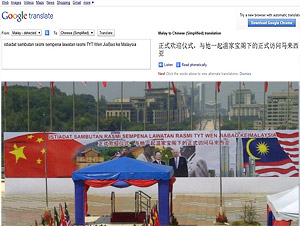 Google Translate
pitfalls also marred an official visit by a foreign head of state, during then Chinese Premier Wen Jiabao’s
welcoming ceremony
in Putrajaya in 2011.
A giant billboard greeting Wen in Malay and Chinese found numerous errors in the latter version resulting from it being done via automated translation.
The Prime Minister’s Department later admitted that the error was due to time constraints that led to the usage of Google Translate without checking the accuracy of the results.
Additional reporting by Kow Gah Chie.


Report this comment
Are you sure you want to delete this comment?
This action cannot be undone.