




Declining air quality in Sarawak as hotspots increase
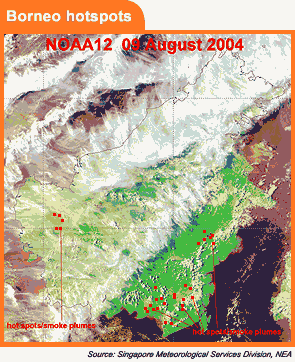
The air quality in Sarawak is deteriorating as the number of hotspots detected over Kalimantan, Indonesia, by US National Oceanic and Atmospheric Administration (NOAA 12) satellite images shot up to 42 yesterday.
The air quality in Sarawak is deteriorating as the number of hotspots detected over Kalimantan, Indonesia, by US National Oceanic and Atmospheric Administration (NOAA 12) satellite images shot up to 42 yesterday.
 A thin haze has enveloped Kuching due to transboundary smog from open burning activities in neighbouring Kalimantan.
A check with the Department of Environment (DOE) revealed that, except for Limbang where the air quality was rated as 'good', the situation in the other 10 divisions in Sarawak has declined to 'moderate'.
DOE has stopped issuing numerical readings of the Air Pollutant Index (API) and only rates the air quality as good, moderate, unhealthy and hazardous. In 1997, when numerical readings were issued, these surpassed 700 in some parts of Sarawak (600 is deemed hazardous).
Although the number of hotspots in Borneo has remained relatively low, an increase in fires has been recorded in West Kalimantan since late June. Many nearby areas have been experienced 'unhealthy' air quality as a consequence.
New system
In an attempt to strike a balance between economic prosperity and sustaining natural resources, Sarawak has introduced controlled open burning based on the Canadian fire danger rating system.
State Environment and Public Health Minister Michael Manyin said recently that this is to enable plantation and forest development while safeguarding environmental quality and sustainable development of natural resources.
The weather-based system, administered by the Natural Resources and Environment Board, was launched recently. Open burning is prohibited if the API reading reaches 100.
Plantation owners and contractors are only allowed to carry out controlled burning on mineral soil and not peat soil.
"Pre-established criteria for open burning, including readiness of manpower, firefighting equipment and fire breaks have to be complied with, before any burning is allowed," Manyin said.
"They should not burn if the fire danger rating shows high risk of fires burning out of control. No overnight fire is allowed. The board will issue the daily risk level for guidance in burning, to give early warning of a developing fire potential.
Meanwhile, the number of hotspots detected via OAA 16 satellite images over Sumatra has risen to 148, compared to 25-50 just last week. The majority are in Riau which, together with Jambi, had contributed to an earlier episode of haze in Peninsular Malaysia this year.
DOE air division director Che Asmah Ibrahim was quoted by The Star as saying that it is too early to conclude that the haze is back.
The number of hotspots detected in Sumatra and West Kalimantan peaked in the middle of this year but gradually decreased with the return of wet weather in late June.
JIMMY TEOH is malaysiakini' s Sarawak-based stringer.


