




Swak mulls cloud seeding operations
Cloud seeding operations may be carried out in Sarawak if the current haze and dry weather continues to persist, said Natural Resources and Environment Board (NREB) deputy chairperson James Davos Mamit.
Cloud seeding operations may be carried out in Sarawak if the current haze and dry weather continues to persist, said Natural Resources and Environment Board (NREB) deputy chairperson James Davos Mamit.
"There will be rain if there is cumulus clouds, if there is none, then cloud seeding can be carried out," he told reporters yesterday.
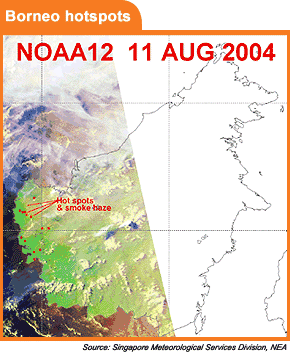 He said 175 hotspots have been detected in Kalimantan and there were 20 in Sarawak, mostly involving shifting cultivation activities by traditional self-sufficient farmers.
Unlike his federal counterparts, Dawos was more open with the Air Pollutant Index (API) statistics.
He said the haze in Sarawak was still moderate where the API reading is between 50 to 90.
The highest API reading was in Sri Aman and Kota Samarahan, which stood at 91 and 92 respectively.
"They are closer to the border in Kalimantan Barat," he explained.
"We do not really see the smog as thick as it should be, this is because we get open fires and open fires mean complete combustion, which is complete burning," he said.
Hazardous to health
However, Dawos warned that particulate matter, which is 10 microns and below, existed in such air and this was hazardous to health.
"At this point in time, it is mild haze or moderate haze, and it is not really hazardous to our health, but even so the public should drink plenty of water and not go out in the open unnecessarily," he said.
He said the public should start adorning masks if the API reading reaches 100.
Meanwhile, Sarawak's disaster relief committee will meet tomorrow to discuss the threats posed by the current haze and El Nino weather phenomenon.
 Its' chairperson, Deputy Chief Minister Dr George Chan said he was informed that the El Nino effects could worsen the situation and cause floods at the end of the year.
Though the situation in Sarawak is still under control, Chan said preventive measure have to be carried out to minimise the effects.
JIMMY TEOH is malaysiakini 's Sarawak-based stringer.


