




Pontianak NGO fights a losing war against haze
The Internally Displaced Persons (IDPs) resettlements set up by the West Kalimantan provincial government in peatland areas had contributed to the haze problem, observed the Pontianak-based Yayasan Konservasi Borneo (YKB).
The Internally Displaced Persons (IDPs) resettlements set up by the West Kalimantan provincial government in peatland areas had contributed to the haze problem, observed the Pontianak-based Yayasan Konservasi Borneo (YKB).
 The resettlements, for mainly victims of the ethnic riots, in peatland areas are deemed to be the cheapest option but this policy has created new problems, said Dr Gusti Zakaria Anshari.
"All new settlers have little or no experience at all in practising peatland agriculture. The common and current method of peatland agriculture is the use of fire," he said.
Gusti warned that although the use of fire is found to be beneficial in the short term, it would damage the peatland.
"Peat is an extremely marginal resource for agriculture, and undervalued for its environmental functions," he said.
Gusti said that through the European Union's Humanitarian Aid Office (ECHO)-funded Land Rehabilitation and Capacity Building project being implemented by International Organisation for Migration (IOM) in Pontianak, they have introduced eco-friendly method.
"It is expected that peatland conservation would secure income-generating activities and would allow the targeted beneficiaries opportunities for sustainable and environmentally-friendly livelihood, while solving the health threatening haze problem," he said.
Gusti said the total size of tropical peatland in West Kalimantan is estimated up to 4.6 million hectares.
"This peatland is mostly situated along the coast of the districts of Ketapang, Pontianak, and Sambas," he said, adding that its ecosystem is extremely fragile.
Long-term solution
He said the ECHO-funded pilot project, involving some 400 households of mainly IDPs and local inhabitants, has been embarked as an alternative.
It also involves families from Aceh who have been transmigrated by the Department of Manpower and Transmigration to the sites.
"The participation procedure of this project is voluntary, co-operative, and puts emphasis on the participants' sense of responsibility towards their own survival and environmental conservation," he said.
Gusti said prospective beneficiaries were asked to register and comply with the project requirements although all those who have decided to join have provided inputs and agreed with the plan of action, including the methodologies to be adopted.
The land rehabilitation project, according to Gusti, consists of three cycles.
The first stage is to build demonstration plots, managed by community groups.
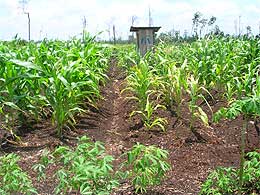 The second stage is to promote the application of ocean mud on individual site of beneficiaries while the final stage of the project involves the private sector in marketing the produce, particularly corn.
"The project intends to ensure that the beneficiaries will have sustainable sources of livelihood by project completion. In West Kalimantan, corn kernels are highly demanded by chicken farms. This crop has been proven to grow well on peatland," he outlined.
Gusti said a businessman has been selected to form a win-win partnership scheme with the IDPs.
"To achieve this, the project would provide post-harvest and basic technical assistance. The selected private sector would guarantee the market by purchasing the harvest, as stated in the agreement," he explained.
'Enemy' of agriculture
Initially, almost all peat swamp forests in West Kalimantan were logged in 1970s, and then opened and reclaimed for agriculture and human settlements.
"Consequently, no intact peatland forest could be found, except in remote location, ie customary peatland forest in Danau Sentarum National Park. For agriculture purposes, peat is treated as an enemy," he said.
Therefore, peatland reclamation is initially conducted by the removal of peat and organic acids.
"The reduction of peat deposit is substantially done by burning and lowering water table. Drainage canals are built in order to wash organic acids and accelerate the rate of peat oxidation.
"Lime is also commonly promoted to improve soil acidity. The use of volcanic ash was also introduced too," he said.
As a matter of fact, all introduced techniques are not proven to be suitable to the current socio-economic condition of the peatland farmers, he concluded.
The current practice is the use of woody ash, rotten fish and shrimps. Woody ash is gathered from sawmills, and the burning of top deposit, dry layer of peat.
An integrated vegetables farming on peatland is found, and mainly practised by Chinese farmers. In this case, most farmers largely depend upon the use of ash derived from wood and peat, some rotten fish, and manure's (both solid and liquid forms) mainly from pigs and chicken.
For years, these vegetable farmers are successful in producing green vegetables and controlling the market. Marketing network and distribution channels have been well established by Chinese traders and farmers.
The present practice seems to face uncertainty since the supply of ash from saw mills rapidly declines, following the sunset of the timber industry in this region.
Haze is born
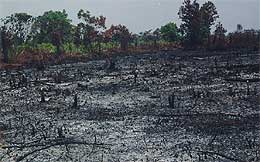 Desperate, the farmers have to cut more trees from secondary peatland forest, and then burn the logs.
"When logs are difficult to find, farmers would burn the top layer of cultivated peat. The removal of peat by fire and oxidation substantially reduce peat depth, and potentially causes the emergence of sulphidic soil, and pyrites," Gusti said.
Worst still, peat fire produces haze that endangers human health and the environment and disturbs the flow of both aerial and surface transportation.
Depending on drainage condition, peatland areas are greatly influenced by rainwater. During rainy season, floods may occur. On the other hand, water level would significantly drop during low rain periods, creating favorable environment for peat fire. As a result, haze is back. Victimising not only nearby residents, but everybody in the region.
"It may get worse as this is the peak time for peatland farmers in West Kalimantan to do land preparation in an area between 3500-4000 Ha, using fire. At night, haze enters houses, and may cause respiratory problems for the elderly and babies.
The condition is still similar to two years ago.
"The government, again, is not well prepared to manage this annual problem.
"Until now, the government and us have not been able to overcome the underlying cause of haze. Perhaps, international cooperation would help us to provide technical assistance for these farmers, and also to ensure that the peatland is properly valued," he said.
Gusti believed this could be done if the agriculture on peatland can be changed from a seasonal activity into an all-year-round activity, with the improvement of seedbed preparation, good nutrient management and good market access.
JIMMY TEOH is malaysiakini's Sarawak-based stringer.


