




Suhakam rapped for unilateral move on media complaints committee
The National Union of Journalists (NUJ) is 'shocked and appalled' with the move by the Human Rights Commission of Malaysia (Suhakam) to set up a print media complaints working committee.
The National Union of Journalists (NUJ) is 'shocked and appalled' with the move by the Human Rights Commission of Malaysia (Suhakam) to set up a print media complaints working committee.
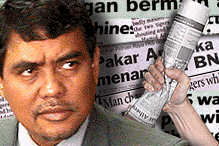 Suhakam yesterday
announced
the formation of the committee under its Complaints and Inquiry Working Group that will receive and probe into alleged journalistic misconduct by the print media, journalists and editors.
Suhakam yesterday
announced
the formation of the committee under its Complaints and Inquiry Working Group that will receive and probe into alleged journalistic misconduct by the print media, journalists and editors.
Contacted today, NUJ president Norila Mohd Daud expressed disappointment over Suhakam's sudden announcement which she claimed was done without prior consultation with interested parties, especially journalists.
"No doubt, Suhakam's intention was good but the way this was done is quite appalling. The NUJ is not saying it is wrong but a decision on this should have been made only after consulting the respective parties."
She said the human rights watchdog should have consulted the representatives of interested groups who were involved in the consultative dialogue held in January to discuss a proposal for a Malaysian Media Council.
Norila also stressed the importance of involving media practitioners when dealing with actual complaints against the media.
"Now there are only two academicians on the new Suhakam committee and they may not be well-equipped to handle complaints against the print media," said adding the Suhakam's role in setting-up the committee was questionable.
"Suhakam only handles human rights issues, not specifically those on press freedom. At the moment, it is not clear who is doing what and why," she said.
Ethics code issue
On a related point, Norila said a suggestion to have a uniform code of ethics incorporated into media companies' collective agreement or as part of their terms of employment would not be practical.
She said that during the general election last March, Chinese national daily Nanyang Siang Pau had tried to impose the company's own code of ethics on journalists but failed due to a very poor response.
"The NUJ does not want to have a code of ethics in journalists' collective agreements. I think it is a matter that should be handled by the respective media organisations. Ethics is more a matter of conscience than compliance to rules and regulations," said Norila.
 She pointed out the NUJ already has an
eight-point code of ethics
that was adapted from the International Federation of Journalists' code which applied to all professional journalists in Malaysia.
She pointed out the NUJ already has an
eight-point code of ethics
that was adapted from the International Federation of Journalists' code which applied to all professional journalists in Malaysia.
In this respect, she said the NUJ disagreed with the Suhakam's print media complaints working committee's suggestion for a uniform code of ethics to be based on a draft code that was prepared for the proposed Malaysian Media Council.
"That draft code was based on the proposal for the media council. Why should we agree to a code that was drafted with editors and media owners in mind?"she asked.
In 1999 and 2000, a two-part petition saw 951 journalists asking the government to repeal the Printing Presses and Publications Act 1984 (PPPA) in return for the opportunity of industry self-regulation.
The government then told the Malaysian Press Institute to draw up a draft proposal for the media council to which journalists objected as it did not include provisions for the repeal of the Act.
The new Suhakam print media complaints working committee is seen as a precursor to the media council which was discussed at the January dialogue. However, the parties failed to agree on whether the council should be statutory or self-regulatory.
Situation complex
One of the groups involved in the dialogue was Inisiatif Wartawan (IW) which reiterated its position that a Malaysian Media Council should only become operational after the repeal of the PPPA or at minimum, the repeal of the Act's annual licencing provision.
Last August, Suhakam had recommended a review and repeal of the PPPA and other laws following a workshop on media freedom.
IW coordinator Padmaja Padman said there was no question that ethics were vital to good journalism practice.
However, she said the new Suhakam committee did not have the right to draw up an ethics code and impose it on journalists adding that such an initiative should be industry-mooted for the best results.
"We are very disappointed that Suhakam had not informed us about their new media complaints committee considering that it is already aware of the complexity of the situation," she said.
"In particular, it should realise the implications of bringing in a proxy media council by the back door, especially in view of the current restrictive environment in which the media operates," she said.
 Padmaja said Suhakam should ask itself if it was in a position to selectively enforce human rights where media operations are concerned when it has failed to obtain the most crucial human right for Malaysians - freedom of expression.
"Without this, the practice of journalism ethics can only go so far in achieving high professional standards before failing. And how will the committee react if complaints are lodged by opposition parties or civil society groups on skewed reports?" she asked.
Padmaja explained that a journalist's duty to fairness and the truth was affected by editorial policies that were necessarily cautious to ensure that media owners' operating licences were not revoked.
"Just like human rights which are indivisible and inalienable, journalism ethics too, should be implemented in its entirety. But this is not fully possible under present circumstances and under prevailing anti-press laws."
Voluntary compliance
Padmaja suggested instead that Suhakam continue to host dialogues with all parties on issues affecting human rights and good journalism practices with a view to achieving voluntary compliance with the universal journalism ethical standards.
At the same time, she added, Suhakam should continue pursuing its own recommendations to the government on the need for a free and independent media.
 "On our part, IW is very clear that any form of a media council must be free, independent and impartial, and that only an industry self-regulatory mechanism should enforce ethics," said Padmaja (
photo, right
).
"On our part, IW is very clear that any form of a media council must be free, independent and impartial, and that only an industry self-regulatory mechanism should enforce ethics," said Padmaja (
photo, right
).
IW is an informal coalition of print and Internet journalists that has spearheaded research in Malaysia on media self-regulatory mechanisms. It forwarded its views to Suhakam on World Press Freedom Day last year on May 3.


