




Don: Discussion on religion still taboo
The past few months have seen vibrant discussion, both public and private, on religion and race as Malaysians become more confident in dealing with such 'sensitive' issues. But strong forces appear to be waylaying such efforts.
The past few months have seen vibrant discussion, both public and private, on religion and race as Malaysians become more confident in dealing with such 'sensitive' issues. But strong forces appear to be waylaying such efforts.
A Muslim scholar from Universiti Malaya's Islamic Studies Academy conceded that a major stumbling block towards true racial integration and religious understanding is Malay insecurity.
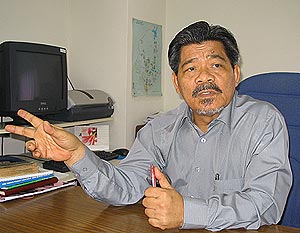 Prof Mahmood Zuhdi Ab Majid likened the current debate on religion or race to a natural state of the country's maturing process.
"This is a period of kocak (turbulence) and it can be very confusing to the different races. As our nation progresses, we are all trying to find an identity for ourselves..
"Not unlike a newly-married couple getting to know each, this is a period of familiarisation for us all," he said in a recent interview.
Referring to the post-Merdeka mood, he said that period was different because people were not concerned about personal identities as much as they are now.
"Most were happy to achieve independence and start a new life, self-government. But now, the time has come for us to actually get to know each other closely. We are all learning about the differences in our lifestyles, and cultural and religious practices.
"Many are finding this experience uncomfortable, but it is something that cannot be avoided in the long run as nation-building is similar to building a family," he explained.
A Bangsa Malaysia?
Describing the socio-religious debates as a turbulent period which Malaysia must undergo, Mahmood said it was normal for each community to demand rights given the prevailing identity crisis.
However, the 59-year-old professor of Islamic studies does not see the formation of an inter-faith council as a way to ease the growing pains experienced by Malaysia as a developing nation with an increasingly affluent urban community.
"Religion is still and will always be a sensitive issue, especially to the Muslim segment. Perhaps one way of getting around this is to focus on cultural integration instead of religious discussion.
"Given the fact that some basic issues are still unresolved, any discussion on cultural, racial or religious differences would most likely touch a raw nerve among many of our people," he said.
According to Mahmood, a Bangsa Malaysia should first be forged before sensitive issues can be discussed openly.
Acknowledging that such efforts for a Malaysian race has been going on since Merdeka, he said the difference now may be the timing.
"Previously, there were calls by first the PAP (People's Action Party) and later the DAP (Democratic Action Party) for a Bangsa Malaysia, but it was too early then as post-colonial sentiments were still raw.
"Over the years, we have made progress culturally. For example, drums, lion/dragon dance, various classical dance and the arts used to be taboo among the different races at one time but now these have been merged into a single Malaysian identity," he noted.
Despite his optimism, Mahmood felt that Malaysians, particularly Muslim clerics, had a long way to go before citizens can truly get over the respective racial and religious hang-ups.
Discriminatory practices
More interestingly, the senior academician linked known discriminatory practices experienced by certain non-Muslim groups, particularly Christians, to Malaysia's history and the nature of political administration.
Due to historical factors, he believed the government has unwaveringly committed itself to resolving issues along racial lines.
Citing Chinese Malaysians who are Buddhists or Taoists, and Malay Malaysians who are constitutionally defined as Muslims, Mahmood said the government tends to attend to the religious needs of citizens based on racial background.
"This may be the reason why Christians probably feel they are persecuted by the government, for instance, by making it difficult to get approvals to build churches. I think it's because Christianity has no specific racial identity.
"I don't think the Hindus, who are ethnic Indians, face problems over building of temples. In fact, you can still see many temples built hundreds of years ago all over the country, including in the middle of major cities," he said.
Thinking aloud, he wondered if it would be easier for Christians to apply for churches based on racial background such as different churches for the Chinese and Indian Malaysians.
"The reality is that even for the Muslims here, there are mosques for Pakistanis and Indian Muslims. But I don't know if this approach would solve the problem," he said.
Understanding needed
On the subject of conversion to Islam, Mahmood said it should be discussed in the context of the country's history.
"Malays were here first. The others came later but were soon controlling the economy and getting involved in politics," he explained.
"Why is it that the non-Malay races fail to comprehend the widespread sentiments of Malay insecurity, given the fact that this is the land of the Malays to begin with?" he asked, looking rather perplexed.
He could not understand why non-Malays found it difficult to accept the fact that the Malays have tolerated the gradual usurpation of the other races into political and economic activities.
"From a Malay perspective, I can say that the Malays have compromised on many things over time, resulting in a real sense of insecurity that has prevailed since colonial rule. The increasing migration of ethnic Indians and Chinese to the then Malaya has also made them realise what was at stake.
"But they continued to remain cordial. So, if any non-Malay was to convert to Islam, why can't the respective community understand and compromise on it instead of getting offensive and bitter?"
Mahmood posed the question of why ethnic Chinese and Indians are unable to realise the kind of opportunities afforded to them by the Malays for a good life here instead of being resentful towards the Malays and Islam?
He felt that as minorities, the respective communities should be more patient and tolerant of the will of the majority, in this context the will of the Malays/Muslims.
Mindset change
"At the same time, I also believe that a public forum on religious or racial issues would cause more damage because Malaysians, particularly the ulama (Islamic scholars), need to undergo a change of mindset," he said.
He said the present crop of so-called ulama were too traditional in their thinking, to the extent of being too powerful in positions of authority.
"There is a struggle, albeit subtle, within the Islamic religious community between the traditionalists and the reformists or modernists, with the former being muftis and religious officers in the government."
Citing his encounters with PAS, a Muslim-based political party seen by many as an authority on Islam, he said his attempts to change some practices failed miserably.
"I tried to change the religious thinking on the act of clapping in applause, the skull-cap and flowing robe as a traditional trademark of an ulama and the act of eating on your feet, but it all failed."
PAS discourages clapping in applause or eating on one's feet as they contradict Islamic etiquette.
Mahmood blamed religious leaders currently in office for being overly-concerned about "petty issues that does not breach the tenets of Islam".


