




Malaysia not out of range of war-hawks sight: US journalist
Anybody in doubt that the United States would consider targeting Malaysia as part of its expansionist policies, merely has to listen to discussion in neo-conservative circles, especially when featured in major American newspapers, asserts US journalist Michael Collins Piper.
Anybody in doubt that the United States would consider targeting Malaysia as part of its expansionist policies, merely has to listen to discussion in neo-conservative circles, especially when featured in major American newspapers, asserts US journalist Michael Collins Piper.
As recently as twenty days ago, on Aug 7, the US undersecretary for defence policy, in the Washington Post, defended his draft proposal in Sept 20, 2001, which suggested Malaysia as one of three countries to be targeted immediately following the Sept 11 terrorist attacks on the World Trade Center in New York, said Piper.
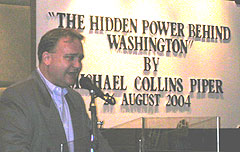 The author of a recently published book on neo-conservatives, Piper is in Kuala Lumpur on a visit sponsored by Yayasan Kepimpinan Perdana. He gave a public lecture entitled "The Hidden Power Behind Washington" in Petaling Jaya last night. About 300 people attended the talk, which was organised by the International Movement for a Just World.
"Just a few days after Sept 11, (Undersecretary of Defence) Douglas Feith was not talking about hitting Afghanistan, where, officially or unofficially, Osama bin Laden may or may not have been hiding. Instead he was talking about two possible places for the United States to attack," claimed Piper.
One of them was the tri-border area between Argentina, Brazil and Paraguay, while the other targeted region consisted of three specified Southeast Asian nations, he stated.
"The other area that Mr Feith was talking about attacking was Southeast Asia. Southeast Asia is a pretty big region, but he had three places in mind: Thailand, Singapore, and Malaysia."
The reason that these three countries were in the sights of neo-conservatives such as Feith, (as is evidenced in his article entitled 'A war-path that cast a wide net'), was the fact that Washington's foreign policy is currently directed and driven by policy-makers who have the security and interests of the state of Israel at the heart of their concern, Piper continued.
"In the old days they looked upon Greater Israel as spreading from the Nile to the Euphrates. Now their dimensions have gotten a little bit more broad based and my country has become the vehicle for this world-wide endeavour."
To back his assertions, Piper cited the Summer 2004 edition of the Jewish Institute for National Security Affairs' (Jinsa) academic journal, which contained articles on several Asian countries together with an article on spy activities in the South Seas.
"This issue is entitled 'Asia Now: China, Japan, Taiwan, North Korea, India, Pakistan'. This (other article) was interesting: 'Espionage in the South Seas'. They (Jinsa) do have a wide-ranging world view," said Piper.
"They're looking at the big picture around the world. These are smart people with a very big agenda and their agenda, unfortunately, can include attacks on any country around the world that for whatever reason is perceived to be harmful to that agenda," Piper added.
Un-American, US foreign policy
Piper continued further to say that the neo-conservatives, the leadership of which was 'largely Jewish', though it had far-right Christian elements within it, had succeeded in using the United States as the vehicle to drive the interests of Israel.
He claimed Israel's interests are consistently placed at the top of the foreign-policy agenda of the Bush administration.
"Frankly, I do think you have to keep in mind that President Bush is...ideologically driven, (with) a particularly religious slant. It's a particular brand, a small slice of Christian fundamentalism that is almost worshipful of the state of Israel."
It was also this centrality of Israel to Christian conservative thinking that allows Bush, among others, to be so easily manipulated by the Israeli Lobby, said Piper.
"George Bush, although he happens to be part of a Christian fundamentalist group, puts Israel as a part of his heart, a part of his soul. That's what makes him so easily manipulated by the
neo-conservatives."
Piper also remarked that it was unprecedented in human history that the sovereignty of one country be usurped by the supremacy of another smaller nation's security interests.
"The leadership of neo-conservatives is in fact largely Jewish, and they are focused almost
exclusively on the security of the state of Israel.
This is so extraordinary - their view is that Israel's security must be placed at the center of all US foreign policy-making," Piper said.
Thus, the notion of 'hidden power', was not completely accurate in describing the situation, said Piper, concluding that it is not so much the identity of the neo-conservatives being concealed, but the agenda, as well as the breadth the agenda embraced.
"These neo-conservatives are not really a 'hidden power behind Washington' because everybody now knows who they are. What is hidden about this power is the centrality of Israel's agenda. That is what a lot of people don't realise and it has effectively been kept under wraps in the United States."
Malacca Straits and US hegemony
Piper, who has been labeled as extremist, bigoted, and anti-Semitic by his detractors, is in Malaysia to promote his book The High Priests of War.
His sponsor, Yayasan Kepimpinan Perdana, was founded by former premier Dr Mahathir Mohamed, also known for his scathing criticism of Jews and the state of Israel.
 Mahathir received particular notoriety in October last year for his comments at the Organization of Islamic Conference Summit when he said that "Jews control the world" and that "they get others to die for them".
Piper's comments last night, however, may revive debate among policy makers and academics in the region, regarding the role and motivation behind moves by the US and Singapore to establish a military presence in Southeast Asia.
In April, Commander of US Pacific forces, Admiral Thomas Fargo, in his testimony to the US House Armed Services Committee, spoke of the need for US Marines and special forces to protect the Malacca Straits.
Further suspicions arose, when Defence Secretary Donald Rumsfeld, whilst attending an Asian security conference in Singapore in early June, affirmed that US interests were at stake particularly, as the area plagued by pirates and possible terrorist attacks.
It is reported that 30 percent of the world's trade goods as well as 80 percent of Japan's oil needs pass through the Malacca Straits.


Are you sure you want to delete this comment?
This action cannot be undone.