




Nepalese workers allege exploitative conditions
Nepalese migrant workers have told their former deputy prime minister that job-related promises have not been delivered by Malaysian agents and employers, eliciting his pledge to raise these issues when he returns home.
Nepalese migrant workers have told their former deputy prime minister that job-related promises have not been delivered by Malaysian agents and employers, eliciting his pledge to raise these issues when he returns home.
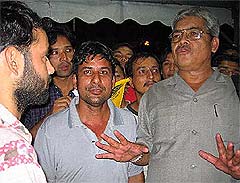 Bamdev Gautam was speaking at Port Klang, the final stop of the Malaysian leg of the People's Caravan which will move on to 13 Asian countries and three in Europe. More than 700 Nepalese migrant workers were among the participants.
He said he would also raise their problems with the All Nepal Peasants Association a network of farmers and the Communist Party of Nepal, of which he is secretary-general.
"We will also notify the consulate about your problems. You have contributed much to the economy and development of this country. You have rights as migrant workers but the only way to claim your rights is to be organised," said Bamdev.
The Caravan, an annual event to promote food and land rights, involves the participation of thousands of farmers' and workers' movements in Asia and Europe. It will end in Nepal at the end of this month.
It is organised by the Pesticide Action Network Asia Pacific, with pro-migrant rights group Tenaganita as its Malaysian partner.
'Duped and exploited'
Nepalese worker Tula R, who represented fellow migrant workers, said he and his colleagues had been promised better wages and benefits before arriving in Malaysia.
"But once we got on the plane, we were forced to sign a different contract with different pay schemes and benefits," claimed Tula, who worked in a local furniture company.
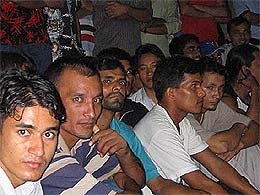 "We feel cheated and exploited. When we tell our employers, they said they had nothing to do with the original contract," he added.
Tula also expressed unhappiness with the Nepalese consulate in Kuala Lumpur, saying the migrant workers were often dismissed and told that "there was nothing that can be done".
In recent years, Malaysia has become a popular destination for Nepalese workers with some studies claiming that over 100,000 are currently working in the country.
Many have alleged that they were duped and exploited by manpower agencies, who take away a large chunk of their earnings, often amounting to three times the cost of obtaining the job.
A study in Lahachok in the Kaski district of Nepal recently showed that nearly half the people in the village could not afford to pay even the minimum Rs 50,000 needed to get a job abroad.
Home Minister Azmi Khalid visited Nepal in June to sign a labour agreement. It is believed that the plight of Nepalese workers in Malaysia had been central to the bilateral discussions.
 Tenaganita director Irene Fernandez told participants that migrant workers were in Malaysia because "the world is not equal".
"Nepal may be poor but it is rich in resources. In Malaysia, we seem to be growing. But it is uncertain to me if we are growing in our hearts," she said.
"We (Malaysians) often treat migrant workers like tools and machines. We just want them to work, work and workCompanies only want profits. But we are all human beings. We have dignity and we must fight for our rights."
SUSAN LOONE is a researcher with the Penang-based Pesticide Action Network Asia Pacific.


Are you sure you want to delete this comment?
This action cannot be undone.