




New bird flu outbreak reported in Kelantan
Malaysia has been hit by a new outbreak of bird flu, officials announced today.
Malaysia has been hit by a new outbreak of bird flu, officials announced today.
The H5 strain of avian flu had killed 30 birds - chickens and quail - on a farm in the north eastern state of Kelantan near Thailand, the veterinary department said.
More tests were needed to determine whether the virus was of the H5N1 strain, which has killed 27 people in Asia this year, a spokesperson said.
The disease was found in Belian village near Pasir Pekan where the first outbreak occurred last month. In that case it was found to be the H5N1 strain which has jumped to humans.
A total of 1,200 birds, chickens and ducks within a one kilometre radius of Belian would be killed immediately to curb the spread of the disease and a quarantine already in place would be extended, the veterinary department said in a statement.
Results to be known tomorrow
"We are continuing with the tests to find out if it is the deadly H5N1 strain. We will know the results Tuesday," Hawari Hussein, the department's director-general told AFP .
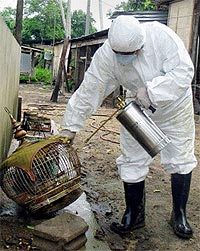 After the first outbreak of H5N1, which the authorities said was restricted to one village, hundreds of birds were culled and veterinary officials launched a nationwide inspection of poultry farms, commercial enterprises and bird parks.
The disease killed eight people in Thailand and 19 in Vietnam earlier this year and the World Health Organisation fears the virus could mutate into a highly contagious form that triggers the next global human flu pandemic.
Malaysia's Federation of Lifestock Farmers Associations said the poultry industry was losing RM10 million daily following import bans by Singapore and other countries after the first outbreak.
Singapore ban
Meanwhile in a related development, Singapore said it was extending a ban on all poultry and egg imports from Malaysia following the new outbreak.
Singapore's Agri-Food and Veterinary Authority (AVA), which regulates fresh food imports, said it had been officially informed of the outbreak by Malaysian veterinary authorities.
"AVA will continue to work with Malaysia to put in place all the necessary safety measures to enable the gradual resumption of imports of poultry and eggs from non-affected regions without compromising public and animal health," a statement said.
It added that there was an adequate supply of frozen poultry in Singapore and prices have remained relatively stable, with Australian and New Zealand exports taking up the slack resulting from the ban.


