




Two hospitalised amid bird flu outbreak
Two people have been hospitalised in Kelantan after a suspected new outbreak of the deadly strain of bird flu that has killed 27 people across Asia, officials said today.
Two people have been hospitalised in Kelantan after a suspected new outbreak of the deadly strain of bird flu that has killed 27 people across Asia, officials said today.
A 10-year-old villager and a veterinary department official working in the area have been admitted to hospital for observation, the director of the Health Ministry's Disease Control Division, Ramlee Rahmat, told AFP .
"We have isolated them as a precautionary measure. We have yet to confirm whether they have been infected with avian flu," he said.
The 10-year-old boy had a fever and cough while the woman from the veterinary department had developed diarrhoea and a fever.
A total of 827 people had been screened by health authorities within a one kilometre radius of the farm in Kelantan state near Thailand where the outbreak of avian flu had killed 30 birds, he said.
"As far as we are concerned, we are treating it as H5N1," Hawari Hussein, veterinary department director-general told AFP , referring to the strain of the virus responsible for the deaths of eight people in Thailand and 19 in Vietnam this year.
"Based on the clinical findings and the fact that it's in the quarantine area, within the 21-day quarantine period, indicates that it is likely to be H5N1," he said.
The department is still awaiting the results of further tests to confirm this, he said.
Culling exercise
The disease was found in Belian village near Pasir Pekan where the first outbreak occurred last month. In that case it was found to be the H5N1 strain, which the World Health Organisation fears could mutate into a highly contagious form that triggers the next global human flu pandemic.
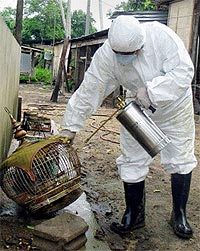 A total of 1,200 birds, chickens and ducks within a one kilometre radius of Belian were being culled while health authorities were conducting house-to-house surveillance of residents in the area.
Singapore, which previously imported some 130,000 live chickens, 20,000 ducks and millions of eggs a day, immediately announced it was extending the ban on all Malaysian poultry and eggs.
Malaysia's Federation of Lifestock Farmers Associations said after the first outbreak that the poultry industry was losing RM10 million daily following import bans by Singapore and other countries.


Are you sure you want to delete this comment?
This action cannot be undone.