




Msian delegate raps food terrorist TNCs
Transnational companies (TNCs) responsible for the destruction of a country's food sovereignty are worst than militants, said a Malaysian delegate who attended the Asia Pacific Research Network (APRN) People's Convention on Food Sovereignty in Dhaka last week.
Transnational companies (TNCs) responsible for the destruction of a country's food sovereignty are worst than militants, said a Malaysian delegate who attended the Asia Pacific Research Network (APRN) People's Convention on Food Sovereignty in Dhaka last week.
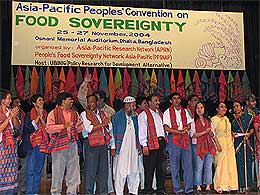 APRN is a network of 33 leading research organisations in 15 countries from the Asia Pacific region, that meet annually to discuss issues such as trade liberalisation, globalisation, development, TNCs and the accession of China into the World Trade Organisation.
When met at the conference lobby, Consumer Association of Penang (CAP) education section head Mohamed Azmi Abdul Hamid labeled these TNCs as "food terrorists".
He said they have been "terrorising agriculture workers and producers with new technologies that do more harm than good".
He explained that there were many manifestations of this terror, which include pesticide poisoning and farmers being evicted from their land.
"TNCs use the law and money (against farmers) and have good access to the government. They are worst than militant groups. They kill a whole generation, from one to the next, and they should be liable for their actions.
"There should be a tribunal to make TNCs accountable for their actions, make them pay compensation and disown their so-called rights over capital.
"... TNCs are conspiring with the government to terrorise the people," he said.
Be sensitive
Former member of Parliament Mahfuz Omar, who was also present at the conference, said governments should be sensitive to the people's concerns over so-called advancements of new technologies which are harmful to health and the environment.
 Mahfuz, who is also the president of Kedah-based Institute of Community Mobilisation and Development, said governments need to be cautious about the hidden agendas of TNCs, which can disrupt the economic condition of the people and threaten food sovereignty of a country.
"Malaysia cannot escape from this threat. We have about 120,000 farmers, 90,000 fisherfolk and about 600,000 agricultural workers. But despite the existence of many government agencies in the sector, these people are the poorest of the lot.
"The agriculture related agencies run by the governments are in dire need of a revamp. We suggest that they go back to the grassroots to help them formulate better policies for the people," he added.
Policy needed
Meanwhile, the Penang-based Pesticide Action Network Asia Pacific executive director Sarojeni V Rengam said Malaysia needed a policy that supports bio-diversity, ecological agriculture that is environmentally friendly and does not harm human health and livelihoods of farmers and consumers.
"The government's policy to increase production through corporate agriculture is environmentally destructive and poses a hazard to human health," she added.
 "By promoting corporate agriculture, decisions are taken from farming families and put into the hands of TNCs, which goes against the very principle of food sovereignty, which is the people's and communities' fundamental right to determine their food and agricultural policies that affect their lives and livelihood.
"It is the right to access and control of their means of production to ensure that their food sovereignty is protected. It is the right to safe, culturally appropriate foods and sustainable food production. Food sovereignty includes gender justice as it recognises the right of women to economic and political rights," said Sarojeni, who is also the vice-president of APRN.
SUSAN LOONE is a researcher with the Penang-based Pesticide Action Network Asia Pacific.


Are you sure you want to delete this comment?
This action cannot be undone.