




Thai Muslim NGOs: We're Thaksin's next target
Leaders of a Muslim non-governmental organisation (NGO) in southern Thailand expect they will be Prime Minister Thaksin Shinawatra's next targets under apparent plans to contain the region's restive provinces.
Leaders of a Muslim non-governmental organisation (NGO) in southern Thailand expect they will be Prime Minister Thaksin Shinawatra's next targets under apparent plans to contain the region's restive provinces.
While targeting religious and community leaders who had called and organised for the social and economic development of the Muslim-majority provinces of Pattani, Narathiwat and Yala, Thaksin had also gone on the offensive against the long-dormant separatist movements Pattani United Liberation Organisation (Pulo) and National Revolutionary Front ( BRN), they said.
 Thaksin may now have set his sights on leaders of social and educational NGOs such as the Young Muslims Association of Thailand (YMAT), while even charities for Muslim orphanages are being watched closely, they added.
According to its vice-president Abdul Aziz Mustafa, YMAT had been as transparent as possible in its finances and other dealings with other Islamic organisations.
Despite keeping everything 'above-board' and legal, however, Thaksin does not seem at all hesitant in labeling Muslim organisations with the terrorist tag and acting against them, he said.
 The precedence, according to Abdul Aziz, lies in the disappearance in February last year of prominent human rights lawyer Somchai Laipachitr, who was also formerly the acting head of YMAT.
Nobody has been charged, although five police officers have been transferred, in connection with the disappearance of Somchai, who is believed to have been killed.
Vision for southern Thailand
"We are merely biding our time. Soon they will come after us," he told malaysiakini during a recent visit by National Association of Muslim Students of Malaysia (PKPIM) to Yala.
Thaksin's intolerance for Muslim groups, and his consequent hard-line policies in the south, derive in part from his vision of development for southern Thailand which conflict with the sensitivities and aspirations of its Muslim Malays, said Abdul Aziz.
"How can Thaksin's party be for us? Thai Rak Thai (Thais Love Thais) is for the Siamese. It's about 'Siamese who love other Siamese'. We're not seen as Siamese," he added.
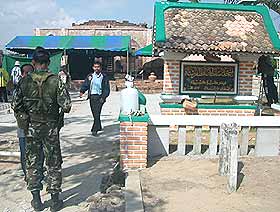 Contrasting with governments prior to Thaksin's election in 2001, some of which had worked closely with YMAT to replicate the latter's successful micro-credit financing schemes as well as its drug-rehabilitation programs, Thaksin seemed to be bulldozing an agenda for the south with complete disregard for what the Muslims may want for themselves, said Abdul Aziz.
Abdul Aziz recounted the example of Thaksin's efforts in Yala several years ago to promote and develop an entertainment belt, complete with dance clubs and bars such as those found in other cities in Thailand, from within the Muslim districts of central Yala.
This met with vehement protests and organisation by Muslim groups, however, who forced the plan which, though not scrapped, was relegated to the outskirts of those districts, said Abdul Aziz.
Adding further to his comments was another YMAT vice-president Nik Mohd Nasir Nik Abdullah, who cited Thaksin's disdain for YMAT's educational and religious efforts by recently forcing its daily Islamic radio programme off the air.
"Up until three months ago, from two to three o'clock in the afternoon, we used to be on air every day. Now, it's prohibited," he said.
"In its place, there's a lot of military propoganda. Between 7.30 to 9.00 every night, there is only military propaganda replete with militaristic and nationalistic songs."
Outside help frowned upon
According to Maryam Samoh, who manages a home for more than 100 poor and orphaned girls in Pattani, even she has been forced to refuse several poor and orphaned children whose parents were involved in the recent Tak Bai and Krue Sek Mosque tragedies.
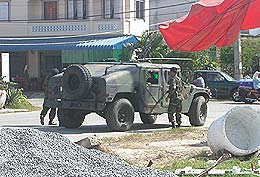 "We have accepted a few into our home, but we don't publicise these cases. We have to refuse many others, such as those whose fathers had died in Tak Bai or Krue Sek, because we don't want to be seen as their supporters or acting on the other side of the conflict," she said.
Head of Narathiwat province's Islamic Council Abdul Rahman Abdul Samad lamented the government's suspicions of financial donations, especially those coming from outside Thailand, to the families of Tak Bai and Krue Sek victims.
However, such assistance was given in trust to the Council to alleviate suffering, and as such compelled him to continue distributing the aid.
"We know the government frowns upon such assistance from outside Thailand. This is not unusual with governments. But on our part, we have been entrusted to accept the help and distribute it to the people."


Are you sure you want to delete this comment?
This action cannot be undone.