


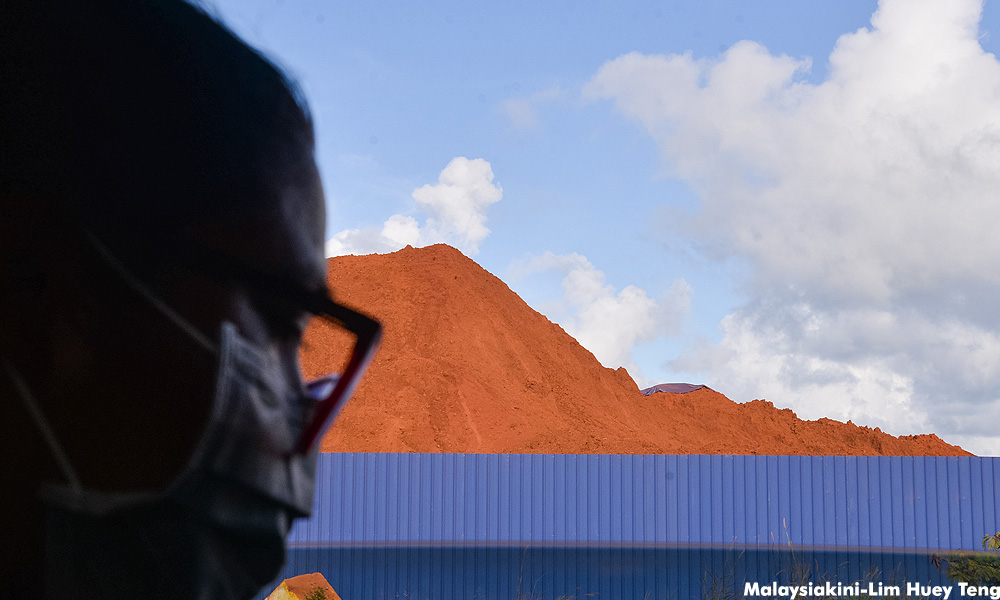

Where's the gov't's conscience in bauxite botch-up?
COMMENT Because the menteris besar in some of our peninsular states are no longer paying attention to the people’s grievances, the non-government organisations and journalists are doing more justice to the people.
Like I mentioned in Part 1 of this series, in some states, the state chiefs appear indifferent towards the environment or the ecological balance, which is so important for the livelihood of the local community, and their future generations, and they continue to issue concessions to capitalise on the state’s natural resources.
Whenever a disaster hits, some of these menteris besar can only deny that it was caused by the degradation to the environment, which their logging and mining concessions have caused.
COMMENT Because the menteris besar in some of our peninsular states are no longer paying attention to the people’s grievances, the non-government organisations and journalists are doing more justice to the people.
Like I mentioned in Part 1 of this series, in some states, the state chiefs appear indifferent towards the environment or the ecological balance, which is so important for the livelihood of the local community, and their future generations, and they continue to issue concessions to capitalise on the state’s natural resources.
Whenever a disaster hits, some of these menteris besar can only deny that it was caused by the degradation to the environment, which their logging and mining concessions have caused.
Lives and safety of the people are no longer important to them. As one expatriate commented over WhatsApp to me, and I cannot help but quote him on his personal observation regarding the bauxite mining in Pahang: “It is a terrible problem. It only shows that there are people out there, authorities at that, who would take the money, when the loss or damage to the people are probably a hundred times more!”
We cannot help when people, including expatriates, are equally concerned about the environment, but the people vested with the power to act, chose to remain oblivious to the people’s grievances and did not appear to understand the impact that excessive mining or logging activities have to the people and their livelihood.
Recently, while on holiday at Taman Negara, and going on the rapids shooting was fun, it also gave me an opportunity to listen to a boat operator who told me: “Lately, the water is slowly turning ‘brown’ (or murky).” He suspected it could be due to some logging activities upstream.
I can imagine what may happen to the rivers in Pahang when I look at the Gombak and Klang Rivers, if logging activities and other development projects continue to be carried out indiscriminately without proper supervision by the authorities.
The same can be said about the Lynas issue, where radioactive materials are involved. Without proper procedures, coupled with allegedly corrupt officers, the management of bauxite mining in the state has gone awry.
NGOs have more conscience
Malaysian Nature Society president Henry Goh has been following the news of the bauxite rush for several months. He, too, is amused at the lack of action on the part of the authorities.
“Despite much publicity surrounding this issue,” he said in his statement to the press, “there was no action taken by any of the ministries and enforcement agencies to investigate an incident, which could cause long term damage to the health of the public and also to the environment.”
Only after the bauxite rush hit the headlines, and the Malaysian Anti-Corruption Agency (MACC) nabbed a few land officers, Goh said this should “serve as an example and a deterrent to others.”
He hopes that more proactive actions will be taken proactively to “ensure that incidences of a similar nature are not allowed to escalate into a major national and international incident, for the wrong reason.”
Pertubuhan Pelindung Khazanah Alam Malaysia (PEKA) has also voiced their concern over the indiscriminate mining of bauxite.
Shariffa Sabrina Syed Akil wrote: “I do not agree with the temporary measures the federal and state government have taken by ceasing the mining of Bauxite for only three months.
“Bauxite is highly hazardous and detrimental to the sustenance of our eco-system, not forgetting the health of the rakyat.
“It’s already been proven without a doubt how dangerous it is, therefore the mines should be shut down immediately. Many other countries know the negative impact it brings and that is the reason why they don’t allow such mining. Why is it mined here and done so recklessly? It boils down to greed.”
According to information published by Mount Sinai Hospital, certain people are more likely to develop aluminium toxicity if they already suffer from diminished kidney function, undergoing haemodialysis, living or working in an environment that contains high levels of aluminium, drinking or ingesting substances that are high in aluminium, receiving long-term IV nutrition, or living in dusty environments.
I can imagine the innocent children of Orang Asli and their elderly folks (they, too, are Malaysians), who live and bathe in the rivers, how the bauxite contamination of the rivers would affect them physically in the long term!
Much to his credit, Health Minister Dr S Subramaniam has suggested that “the bauxite mining in Pahang be halted altogether , if the activity continues to pose a health risk with the polluted waterways and water supply.”
Therefore, both the federal and state governments should not look at the bauxite rush as a political boiling point, but that it has become a national environmental disaster which should be addressed immediately, beyond just the three-months moratorium.
Mining can and should only allowed to continue when well-trained operators are identified to manage the industry with adequate care to the environment and the people’s welfare in mind. Any damage done now cannot be reversed.
Part I: Can we still afford corruption at the state-level?
Part II: Can Adnan or Najib reverse the bauxite rush damage?
STEPHEN NG is an ordinary citizen with an avid interest in following political developments in the country since 2008.


Are you sure you want to delete this comment?
This action cannot be undone.