




Hollow economy and fundamental flaws checking us
COMMENT Allow me to share with you a Blindspot moment here: not many may have taken note that in 2014, 29.1 percent of our total imports were in the form of electrical and electronic (E&E) products. The same year, 35.7 percent of our total exports were also E&E products. What is actually going on here?
Well, simply put, our economy is kind of hollow.
We import cheap components from China, assemble it locally and export the finished products.
COMMENT Allow me to share with you a Blindspot moment here: not many may have taken note that in 2014, 29.1 percent of our total imports were in the form of electrical and electronic (E&E) products. The same year, 35.7 percent of our total exports were also E&E products. What is actually going on here?
Well, simply put, our economy is kind of hollow.
We import cheap components from China, assemble them locally and export the finished products.
Sadly, the finished products that we export are mostly of the Original Equipment Manufacturer (OEMs) type - assembled using cheap labour for foreign companies. We hardly manufacture, nor do we export, our own brands. As a result, on average, the value-added in the E&E products’ production chain is approximately only 15 percent.
We do the same for our textiles, as sweat shops for foreign companies.
The attraction for foreign companies to locate their E&E manufacturing in Malaysia is largely to benefit from cheap labour, cheap subsidised energy, tax holidays; and as a haven to carry out transfer pricing for the purposes of tax evasions.
However, we are not as attractive as we once used to be. This concept of mere assembling will not work in our favour for long if we do not keep up with technology, for other emerging economies offer more competitive production lines.
Additionally, the Trans-Pacific Partnership, via the rules of origin, will upset this hegemony. A post-TPPA formalisation would see us importing from TPP countries to enjoy the reduction in tariff (no longer importing from China) - but that is a story for another day.
Furthermore, since 2009 our nett foreign direct investment has been downright negative until today. Meaning, we invested more in total overseas versus investment coming into Malaysia. TPPA proponents might take a shot here to promote the Investor State-Dispute Settlement (ISDS) clause under TPPA, saying that since we invest more overseas, we would require the protection.
However, such arguments fall flat in the face of the facts - we are not investing overseas in expanding our businesses but more in acquiring properties. Think Mara!
So why is this hollow economy unhealthy?
Why is mere assembling not going to work for the long-term? I am going to explain using the case of iPhones. How much money goes to the respective countries for every sale of an iPhone?
iPhone is an American product that is assembled in China. One would take a guess that a sizable chunk of profits will go to China and America. One might also think that Malaysia is making huge profits by assembling numerous E&E products.
Well, such assumptions are wrong.
 The money from an iPhone sale (source:
The Wall Street Journal
) goes to the following countries - 34 percent to Japan, 17 percent to Germany, 13 percent to South Korea, six percent to the United States and only 3.6 percent goes to China.
The money from an iPhone sale (source:
The Wall Street Journal
) goes to the following countries - 34 percent to Japan, 17 percent to Germany, 13 percent to South Korea, six percent to the United States and only 3.6 percent goes to China.
Why is that so? Because the money will go to paying the high spec and high-tech components that are imported from Japan, Germany and South Korea to make up the iPhone. Assembly line is cheap and does not contribute much added-value.
Thus, in order to compete we need to continuously upgrade our technology and knowledge in order to survive in this fast-paced world.
Instead, we are currently trapped in the middle – we are neither here nor there. We are not cheap and we are not sophisticated enough. We are not able to compete with Vietnam or Indonesia in term of costs, and Singapore in term of technology.
A meaningless number game of average
Back in 2010, the Economic Transformation Programme (ETP) was launched as part of achieving this ambition to elevate Malaysia from the crutch of the Middle-Income Nation trap, which we have been party of since 1996. The goal is to spur the country's growth to achieve the high-income nation status by 2020, through targeting GNI per capita of US$15,000.
Two years later, indeed, Pemandu did announce a huge growth rate in 2012, showing how they’re on track.
But there is a major flaw here: the ringgit to the US dollar at the time of ETP’s announcement was at an average of RM3.52/US$1, while in 2012 it was averaging at RM3.10/dollar. There was a foreign exchange gain here.
However, it is a double-edged sword, the same forex will come to haunt Pemandu as the forex is currently hovering at RM4.30/US dollar. Looking at the current condition, in order to achieve US$15,000 (RM64,500) by 2020, considering that our GNI/capita is RM35,000 in 2014, we need 10.7 percent yearly GNI growth consistently every year until 2020.
This is Mission Impossible. High-income nation status is no longer achievable. We are out of luck. The best we did was when we averaged a nine percent yearly growth between 1988 and 1997, prior to the Asian Financial Crisis.
Regardless, the GNI per capita is just a number game of average. It doesn’t mean anything to the ordinary Malaysian now facing difficulties embracing the fast-paced increase in the cost of living. It doesn’t mean anything to a country plagued with one of the highest inequality in the region.
To explain further, let’s do a simple mathematical calculation:
Our GNI per capita (2014): RM 35,000/capita/year
Average person per household: 4.2
Therefore,
GNI/ household/year: RM147,000
GNI/household/month: RM12,250
These numbers are so lopsided and don’t mean much.
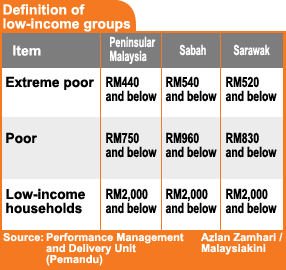
By average, every household is earning RM12,250 a month. However, since we have a wide disparity between the rich and poor, the majority of our population is very far from this average. Seventy-five percent of our households are earning below RM5,000 a month.
Sarawak is a clear example of how a high-income status doesn’t mean anything. Sarawak in 2008 crossed World Bank’s threshold of a high income state by definition, but look at the situation of the people in Sarawak. There is no real meaning to the fixation of achieving a high- income nation status.
‘Export-led’ no longer viable
Back in 2010, the United Nations, via the UN Conference on Trade and Development (Unctad), called for a re-think of the export-led growth economic model foisted onto developing countries in recent decades. Unctad said higher wages and stronger domestic demand were the necessary ingredients for sustained growth.
Three years after that, Unctad again reiterated that policy-makers will need to reconsider development strategies that have been overly dependent on exports. It also said that development strategies should place a greater emphasis on the role of wages and the public sector in the development process. Export-led development is no longer viable, economies will perform better with more balanced strategies.
What does an export-led based economy/development mean anyway? It means that export is our number one priority and we strategise everything economically according to this strategy.
Some of the ways out
According to Unesco, the number of researchers in Malaysia for each one million population is only 365 - behind Japan’s 5,416, Denmark’s 5,300, the United States 4,721, South Korea’s 4,231 and even South America at 384. Our PhD holders slightly passed the 15,000 mark from our 30 million population.
A study released by the Global Entrepreneurship Monitor (GEM) categorises Malaysia as an efficiency-driven economy, behind innovation-driven economies. We focus on improving existing processes, but we are not out there inventing new things where the big money is.
Focusing on the latter is extremely important now, more than ever for Malaysia, because we can no longer offer very cheap labour, land and factories to produce mass generic products competitively.
Malaysia is neither here nor there, and education opportunity is a major contributing factor. Robert Reich, former US secretary of labour and professor at UC Berkeley, made a compelling argument that is very applicable to Malaysia.
To attract jobs and capital, nations and states face two choices: one is to build a low-tax but low-wage “warehouse economy” competing on price; another is to compete on quality, by increasing taxes and regulation to invest in human capital for a highly productive workforce.
 In Malaysia, wage growth caught up with productivity growth only up until the late 1990s. Since 1996, we have been living in the “middle-income trap”, stunted at the World Bank’s definition of upper middle income; neither high nor low income. In fact, for the past 10 years, real wage growth has been negative.
Having 77 percent of the Malaysian workforce with only SPM and below qualification is a structural barrier to us crossing over to the higher income group. The labour force is largely unskilled and unable to move their labour services up the value chain, where higher salaries are paid.
We are in dire need for more trained professionals and innovators, and we could have harvested them from talents that did not pursue tertiary education due to the lack of opportunities. As a developing nation, Malaysia is approaching the last but toughest hurdle in achieving wealth and prosperity; that is a knowledge-based society, driven by intellectuals and thinkers.
Trickle-down economy and an export-led based growth or development have been proven not to work. We need the right economic policy and approach to solve fundamental economic problems and issues. We also need to strictly reduce the number of foreign workers through industry limits and quota and we need to start now.
The only way forward is for Malaysia to provide its citizens with good job opportunities, decent wages and salaries and also an ecosystem that promotes innovation and entrepreneurship in high value products and businesses. We need to start building machine tools and our own equipment.
Let’s not get stuck with the myth of a high-income nation status that doesn’t mean much to ordinary Malaysians. Let’s start thinking how the country can provide opportunities, access and rewards - equally to all its citizenry. A fundamental correction is severely required.
ANAS ALAM FAIZLI holds a post-graduate doctorate degree in Business Administration. He is an oil and gas professional, the author of ‘Rich Malaysia, Poor Malaysians’ and tweets at @aafaizli


Are you sure you want to delete this comment?
This action cannot be undone.