




M'sia fights dengue fever explosion
Malaysia have introduced tough measures to combat an explosion of dengue fever, fining companies and homeowners who fail to control breeding grounds of mosquitoes responsible for a disease usually associated with poor tropical countries.
Malaysia have introduced tough measures to combat an explosion of dengue fever, fining companies and homeowners who fail to control breeding grounds of mosquitoes responsible for a disease usually associated with poor tropical countries.
Health Minister Chua Soi Lek announced a doubling in dengue cases last month, from an average of 450 a week to about 1,000, with the increase especially noticeable in the modern capital Kuala Lumpur. Twelve people have died from the disease since November.
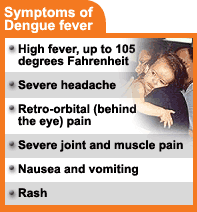 The aedes mosquito which spreads dengue - with its symptoms of high fever, severe headache and muscle pain, rashes and nausea - breeds easily in stagnant pools such as rainwater collected in roof gutters, flower-pots, pails and other containers left in the open.
Abandoned building projects and construction sites, found to be the main dengue culprits in Malaysia, will be targeted in a clean-up campaign to be launched in the capital in an effort to stamp out the menace.
Chua said owners of a total of 14,186 premises had been fined and 59 people brought to court last year after mosquitoes were found breeding in their compounds.
"We are concerned about this increase, the current rainy season may cause the situation to worsen," Ramlee Rahmat, director of the health ministry's disease control division director told AFP .
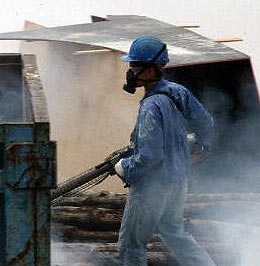
Government counter-measures such as fogging with sprayed insecticides and destroying mosquito breeding grounds would be increased but all Malaysians should also inspect their premises regularly.
"We want to ensure that the situation does not get out of control," he said. "We do not want to create panic, but we want the people to know there is an increase compared to last year.
"The public can't afford to be complacent. They must check and clean their homes regularly to break the transmission of dengue. Otherwise the situation would become an epidemic."
Same across the causeway
In neighbouring Singapore, known for its clean, green cityscape, dengue has also become a serious health issue.
Singaporean authorities recorded more than 8,500 dengue cases in 2004, a 10-year high and almost double the number in 2003.
 Starting next month, the city-state plans to impose fines on homeowners found with mosquitoes breeding on their premises.
Private homes rather than construction sites are the main breeding grounds of mosquitoes in Singapore and first-time offenders will be fined the equivalent of 60 US dollars, and double that for the next offence.
Most Singaporeans live in apartment buildings but many families keep potted plants and other receptacles in which mosquitoes can breed.
Penalties for construction sites where mosquitoes are found breeding are much stiffer and can include up to six months in jail for those responsible.
To the north of Malaysia, in Thailand, the health ministry's disease control division said it recorded about 30,000 cases of dengue last year, involving 40 deaths.
No statistics on past years were immediately available, but an official said the situation had improved over the past three years "as the country has educated people about dengue fever -- how to avoid getting bitten and how to clear watery areas where mosquitoes breed".
Major concern
World Health Organisation says on its website that dengue has in recent years become a major international public health concern.
Dengue haemorrhagic fever (DHF), a potentially lethal complication, was first recognized in the 1950s during dengue epidemics in the Philippines and Thailand, but today DHF affects most Asian countries and has become a leading cause of hospitalisation and death among children in several of them.
The WHO says the global prevalence of dengue has grown dramatically in recent decades and the disease is now endemic in more than 100 countries in Africa, the Americas, the Eastern Mediterranean, Southeast Asia and the Western Pacific.
There is no specific treatment for dengue fever, but victims are often hospitalised or advised to get plenty of bed rest, drink lots of fluids and take medicines other than aspirin to reduce fever.


