




Traumatised Aceh kids, like Rizman, need help
Twelve-year-old Rizman Rizki walked into Malaysia's Yayasan Amal clinic in Lhamlagang in the suburb of Banda Aceh yesterday with a daze look in his eyes.
Twelve-year-old Rizman Rizki walked into Malaysia's Yayasan Amal clinic in Lhamlagang in the suburb of Banda Aceh yesterday with a daze look in his eyes.
Just hours earlier, he was reunited with his uncle, now his only living relative having lost both his parents and all siblings to the tsunami that hit Aceh three weeks ago.
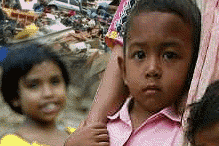 His uncle told the volunteer doctors that he was worried about the boy's health after living with strangers in a mosque for the past 18 days.
Rizman was hesitant about talking at first but after some coaxing, he related on what he went through that fateful day when he was saved by "a stranger in white" who pulled him into the mosque seconds before the strong currents could sweep him away.
"Children like Rizman need careful care and attention so that they can continue with their daily lives. He may appear alright, talking normally but you know something is wrong when you look into his glazed eyes. He's here but his mind is elsewhere. It's so sad," said the doctor who attended to him.
 Medical volunteers in Banda Aceh are aware of the need to treat traumatic tsunami survivors like Rizman who have lost not only their entire family but also their sense of direction.
Post-traumatic syndrome
One of them is Dr Mohd Ikram Mohd Salleh from Mercy Malaysia who is trying to coordinate a group of psychologists and psychiatrists in the next batch of volunteers to Aceh.
"Psychological trauma is one of the of most serious illnesses in Aceh. On Thursday, we went to Pulau Aceh where two-third of its 10,000 population were killed in the catastrophe. About 400 children there were made orphans following the tragedy," he informed malaysiakini.
"Most of them require attention. They don't really need medication. When you ask them sakit apa (what's the ailment?) they would say that they can't sleep and have heart palpitations. All these are part of post-traumatic syndrome," he said.
Ikram said Mercy planned to establish two orphanages - in Babunnajab and Kuta Baro in Banda Aceh - to house the children.
"We hope to place groups of psychiatrists and psychologists at the orphanages as soon as possible. We hope to gather the volunteers soon," he added.
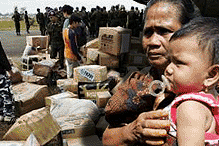 At the moment, the doctor said that they tried to ease the situation by going around to attend to as many people as possible with the limited volunteers at hand.
"We go from one relief camp to another in our mobile clinic and talk to the traumatised lot, children and adults, to help ease their pain. Thankfully, some seemed to be on the way to recovery but there are others who need serious attention especially those who refuse to talk and stare at you with a blank face."
Easing burden by talking
Yayasan Amal's Dr Rayney Azmi Ali said one way to help traumatised patients is to allow them to speak of their experience.
"They almost have the same stories. Two out of 10 patients we received are stressed by their experience. Apart from physical illness - most were carried for miles by the strong currents and swallowed a lot of water- they also appeared jittery and restless.
"Hopefully, when they relate their experiences, their burden can be eased. Doctors usually say nothing. Listening seems to be enough for them," Rayney said.
Meanwhile, an international scientologist group is also doing their bit to help those traumatised by the tsunami in Aceh.
One of their volunteers, known only as Lucas, said they would try to help not only the survivors, relatives of victims and friends but also relief workers and volunteers..
"We also need to assist the volunteers, particularly those involved in searching and removing corpses. They were through a very harrowing experience," he said.
ARFA'EZA A AZIZ, malaysiakini's chief reporter, files this story from Banda Aceh.


Are you sure you want to delete this comment?
This action cannot be undone.